
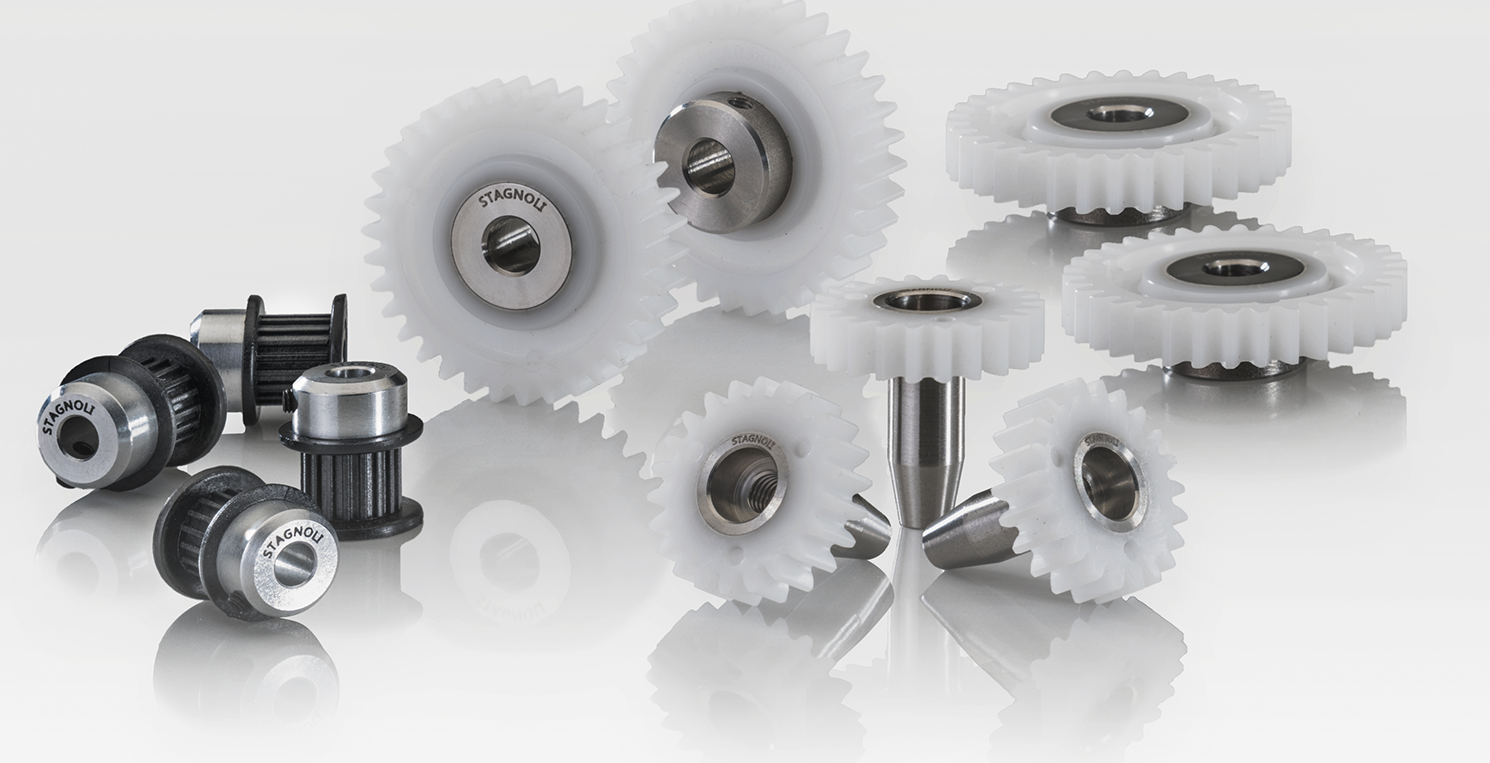
Plastic gears get specified for all sorts of reasons: they’re lighter than metal, they don’t corrode, and they’re often cheaper to produce in volume. In the right application, they perform well. In the wrong one, they fail quickly and expensively.
The decision to use plastic instead of metal isn’t just about cost or weight. It comes down to a handful of engineering criteria that need to be assessed honestly before you commit to a design. Get the full breakdown below.
What Plastic Gears Do Well
Plastic gears handle light to moderate loads efficiently, particularly in consumer electronics, small appliances, medical devices and office equipment. They dampen noise well, which is why you’ll find them in printers and camera mechanisms where metal-on-metal contact would be unacceptably loud.
They’re also self-lubricating to a degree. Materials like acetal and nylon have low coefficients of friction, which means they can run without grease in applications where contamination from lubricants would be a problem, such as food processing or cleanroom environments.
How Material Choice Affects Performance
Not all plastic gear materials are equivalent. When gears are machined instead of moulded, the acetal sheet is the most common starting point. It machines cleanly, holds tight tolerances well, and its dimensional stability means finished gears won’t creep or warp under load the way some other polymers can.
Nylon is also widely used but absorbs moisture, which causes it to swell. That can be a real problem in precision gear trains where the tooth profile needs to stay consistent. Acetal doesn’t have this issue, which makes it more predictable over time, especially in humid or wet environments.
Load, Speed and Temperature: The Three Limits
Most plastic gear failures come down to one of three things: too much load, too much speed, or too much heat.
Load is the obvious one. Plastic gears have a lower tensile strength than steel or aluminium, so they’ll deform or fracture under loads that a metal gear would handle without issue. What’s less obvious is that even moderate loads can cause problems if they’re applied cyclically over millions of cycles, as fatigue failure builds up in the tooth roots.
Speed matters because friction generates heat, and heat is where plastics lose their mechanical properties fastest. A gear running at high RPM in a tight mesh will get warm even with lubrication, and once you’re past the material’s thermal limit, you’ll see accelerated wear or sudden failure.
Temperature is the third constraint. Most engineering-grade plastics start to soften somewhere between 100°C and 150°C. If the gear is anywhere near a heat source, or if frictional heating can’t be dissipated, metal is the safer option.
Where Plastic Gears Shouldn’t Be Used
There are some applications where plastic gears are simply the wrong tool, regardless of material grade:
- High-torque drives – gearboxes in industrial machinery or automotive drivetrains generate loads that plastic can’t sustain reliably.
- Continuous high-speed operation – sustained RPM builds heat faster than the material can shed it.
- Elevated ambient temperatures – anything near motors, engines or ovens risks thermal degradation over time.
- Shock loading – sudden impact loads, as in some indexing mechanisms, can cause brittle fracture even in tougher polymers.
In these situations, sintered metal or machined steel gears are the better call. Trying to substitute plastic to save cost in a high-stress application will usually result in early failure and higher total costs.
The Final Take
Plastic gears work well when the application is designed around their actual properties, not around the assumption that they’ll behave like metal. If the loads are light, speeds are moderate, temperatures are controlled, and noise matters, they’re a sensible choice.
When any of those conditions aren’t met, it’s worth being honest about whether the material is right for the job. A well-specified plastic gear will outlast a poorly-specified metal one, but the reverse is equally true. Matching the material to the real operating conditions is what makes the difference.