
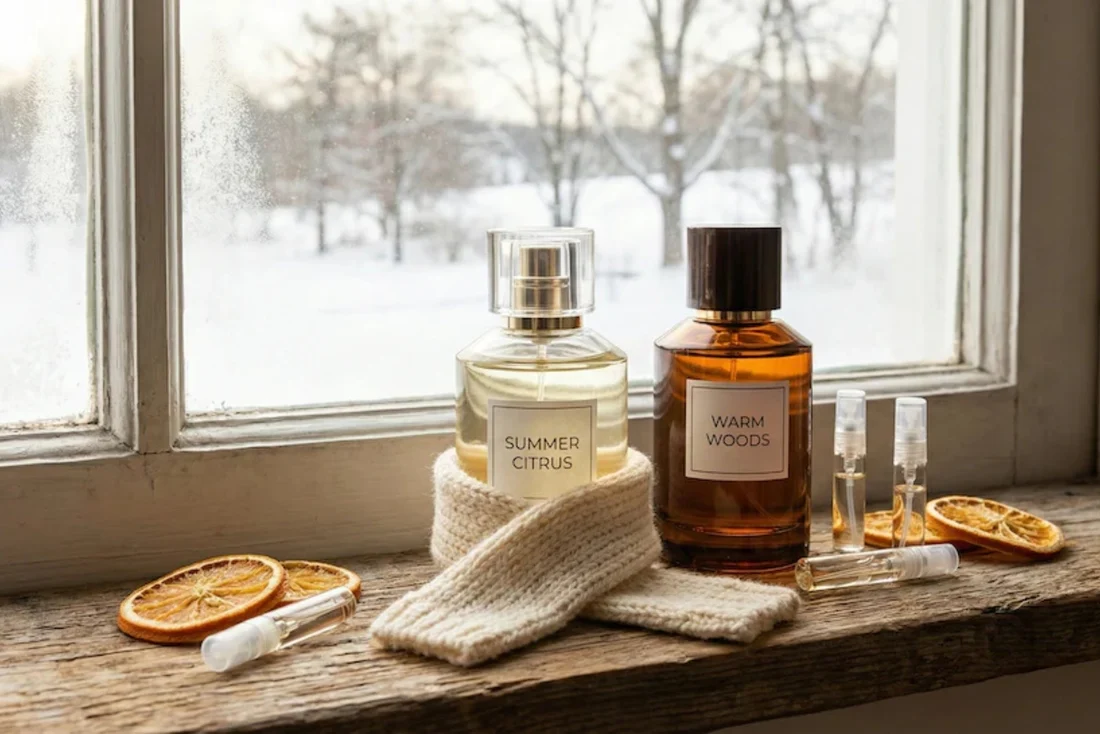
A perfume you loved on a cool evening can feel too sweet on a hot afternoon. The reverse happens too: a citrus you wore all summer may still smell good in winter, but you barely notice it once you’ve pulled on a jersey and left the house. It’s tempting to put both bottles into neat seasonal categories. Before you do, think about where you were and what you wanted the perfume to do.
Some fragrances suit summer or winter better because temperature, airflow and the amount you apply can change how noticeable a scent is, while your surroundings can change how much of it you want to smell. A bright cologne may feel more comfortable on a hot day. A spiced or woody perfume may be easier to enjoy when you’re cool and have some space around you. Either can work out of season.
The practical rule is to choose where you’ll spend the most time after spraying. A cold trip to the office doesn’t tell you much about the warm meeting room you’ll sit in all morning. If your favourite perfume still smells right but feels too strong there, change how much you spray before you change bottles.
What temperature changes, and what it doesn’t
Perfume reaches your nose as fragrant materials leave the surface you sprayed and move into the surrounding air. In research modelling perfume diffusion from skin, R. Schwarzenbach and L. Bertschi identified temperature, ventilation and the amount of fragrance relative to the surface it covered as important factors. That’s a better starting point than assuming every perfume behaves the same way once the temperature rises.
On a warm day you may notice more of a perfume early on. That tells you how present it feels at that point. It doesn’t tell you when the last trace will disappear. Projection is how far away it’s noticeable. Longevity is how long it remains detectable. A scent can be easy to notice during the first half-hour and stay close to the skin later. Another can remain detectable for hours without ever filling a room.
There’s also no single rate at which everything in a perfume leaves your skin. In a study measuring evaporation on volunteers, researchers found that evaporation varied with the fragrance molecules and with measured skin properties. They studied specific materials under controlled conditions, rather than finished perfumes worn through a South African winter or summer. The useful point for shoppers is that one rule about heat or cold can’t tell you how long every perfume will last on you.
The conditions around you change during the day as well. A sleeve can cover the spot you sprayed. Air moving past you outdoors can carry scent away from the person standing next to you, while a still room may make it easier to notice nearby. If you can’t smell much while you’re walking outside in a coat, wait until you’re indoors and settled before deciding you need another spray.
Shop for the hours after the opening
Citrus peel, green herbs and airy florals often appeal in summer because people find those effects refreshing. In cooler weather, you might enjoy the warmth you associate with woods, spice or vanilla. Those associations are useful when you’re searching online. Trouble starts when the first few notes become the whole reason for choosing the bottle.
Take two perfumes that both feature orange. Hermès describes Eau d’Orange Verte Eau de Cologne through orange, mint and moss. If you want a green, crisp direction for a hot afternoon, that combination gives you a reason to sample it. The moss also tells you there’s more to the description than a burst of citrus.
ScentRepublic’s listing for Versace Eros Flame Eau de Parfum describes an orange and spice opening that moves towards a creamier vanilla character. That could be a better lead for someone who likes brightness at first but wants sweetness and warmth later. If you want the orange to keep feeling crisp well into a hot afternoon, that same description gives you a reason to test it before buying.
This comparison comes from product descriptions, rather than timed wear tests. It shows why two listings can share a note and still suit different jobs. When you shop for a summer perfume, look at what follows the citrus. When you shop for winter, decide what kind of warmth you want before assuming it has to be sweet.
For a drier direction, ScentRepublic’s Hermès Bel Ami listing describes leather with an earthy, lightly smoky edge. That’s a different sort of cool-weather candidate from a creamy vanilla. It’s worth investigating if you enjoy leather; skip it if smoke is the very thing that sends your current winter bottle to the back of the cupboard.
Your day can matter more than the season
The South African Weather Service’s climate overview distinguishes the summer rainfall pattern across much of the country from conditions in the south-western and southern regions. Even within one city, the weather outside doesn’t tell you what wearing a fragrance will feel like for the whole day. An outdoor lunch in Durban, a cold Johannesburg morning that leads into a warm office, and a windy Cape Town evening ask different things of a scent.
| Where you’ll wear it | Try this first | When to consider another fragrance |
| A hot, close commute followed by an indoor day | If the scent already feels strong, use less and judge it after you arrive. | You still find the later sweetness, spice or smoke distracting at the lower dose. |
| A cool walk followed by a heated room | Apply for the room you’ll spend hours in. Give the perfume time indoors before topping up. | You like the scent but can’t find a dose that feels comfortable through the transition. |
| A warm outdoor lunch or a breezy evening | See how the perfume wears in the open air. Make your judgement before moving somewhere enclosed. | The scent feels too heavy for you in the heat, or you prefer a brighter character altogether. |
| A cool evening indoors | Try the fragrance you already own at your normal dose, even if it’s marketed as a summer scent. | You enjoy the opening but want more texture or warmth once it settles. |
Consider the move between settings. ScentRepublic mentioned that you could enjoy a rich vanilla outside at an evening braai, then find it too present on the drive home. An airy scent can be exactly what you want at a winter desk even if it seems quiet on the way in. Try to solve the recurring problem: a crowded car, a warm room or a long outdoor afternoon. A label that says “winter” or “summer” can’t tell you which of those matters most.
How to tell whether you need a new perfume or one less spray
Start with a bottle you like that has recently felt wrong for the weather. Think of the last time you wanted to take it off or wished you could smell more of it. Was it too strong, or was there something about the smell itself that bothered you? That distinction saves you from buying a lighter version of a scent whose sweetness you didn’t enjoy in the first place.
On a comparable day, wear it again with a small change. If it feels too loud and you usually spray twice, try once. Keep the application spot and the rest of your routine roughly the same. If it seems to disappear on a cold morning, check it once you’ve taken your coat off and spent some time in the room where you work. If you can, ask someone you trust whether they can notice it at normal conversational distance before assuming it’s gone.
Note what happened after the commute and again later. “Still like the vanilla at lunch, but one spray is enough” is a clear reason to keep using the bottle. “Still too sweet after lunch, even though it’s much quieter” points to a different scent profile. In the second case you can keep something you enjoy, perhaps the bright opening, and look for a drier base.
If you’re comparing samples, try them on separate days in similar settings. Testing one in a cool shop and one after an hour outdoors tells you about two fragrances and two environments at once. A repeat wear in the setting that caused the trouble will help you decide which difference matters. There’s no need to turn it into an experiment with a spreadsheet; two useful observations are often enough to make a better purchase.
When a seasonal rotation is worth paying for
Keep one perfume if you enjoy its character across the year and can adjust the amount without losing what you like about it. That’s especially sensible if most of your wearing happens in a similar indoor setting. You may need less variety than someone whose weekdays and weekends take place in very different conditions.
Add a second fragrance if the gap keeps showing up. Perhaps you like a spiced amber through winter but find yourself going without perfume on hot workdays because the dry-down feels too rich. That’s a good reason to sample something crisp or less sweet. If your existing citrus already works for those days, give it a few wears before you order another one. The new bottle should give you something you’ll use.
If you only want a richer scent for occasional cold evenings, check for a sample, travel size or smaller bottle before committing. Compare the total price in rand with delivery, especially if you’re ordering from an area where you can’t easily visit a counter. A sample that you can wear in the conditions you’re buying for is more informative than a large bottle you chose because its description sounded cosy.
Frequently asked questions
Can I wear vanilla or amber perfume in summer?
Yes. Try your usual perfume at a lighter dose, or save it for an evening when you’ll have more space around you. If its sweetness still bothers you once it settles, look for a less sweet fragrance rather than simply applying less and hoping the character will change.
Why can’t I smell my perfume outdoors in winter, then notice it again inside?
Your application spot may be covered and the air around you may be moving. Indoors, you may uncover the spot and spend more time in still air. Before you spray again, give yourself time to see what’s already there.
Should I choose an eau de toilette for summer and an eau de parfum for winter?
Use the concentration label to identify the exact version. It can’t tell you by itself which perfume will feel airy, sweet or loud on you. Read what each version smells like once it settles, then compare them in the kind of place you plan to wear them.
What if I live somewhere with a mild winter?
Shop for the days you actually have. If your daytime routine and clothing don’t change much, your usual fragrance may still suit you. A second scent makes more sense if it solves a specific problem, such as wanting a richer option for the evenings you spend outside.
Is the air-conditioned shop a bad place to test a summer fragrance?
It’s useful for finding out whether you like the scent enough to keep testing. For a perfume you’ll wear mainly outside or during a warm commute, spend part of the day in that setting before buying. See whether you still enjoy what’s left once the opening settles.
Before buying a winter or summer perfume, name the setting and what goes wrong with your current bottle there. If it’s too noticeable, change the dose and try again. If the smell itself feels wrong, use that detail to shortlist a different scent. You’ll get more out of the next bottle when it solves a problem you’ve actually had.