
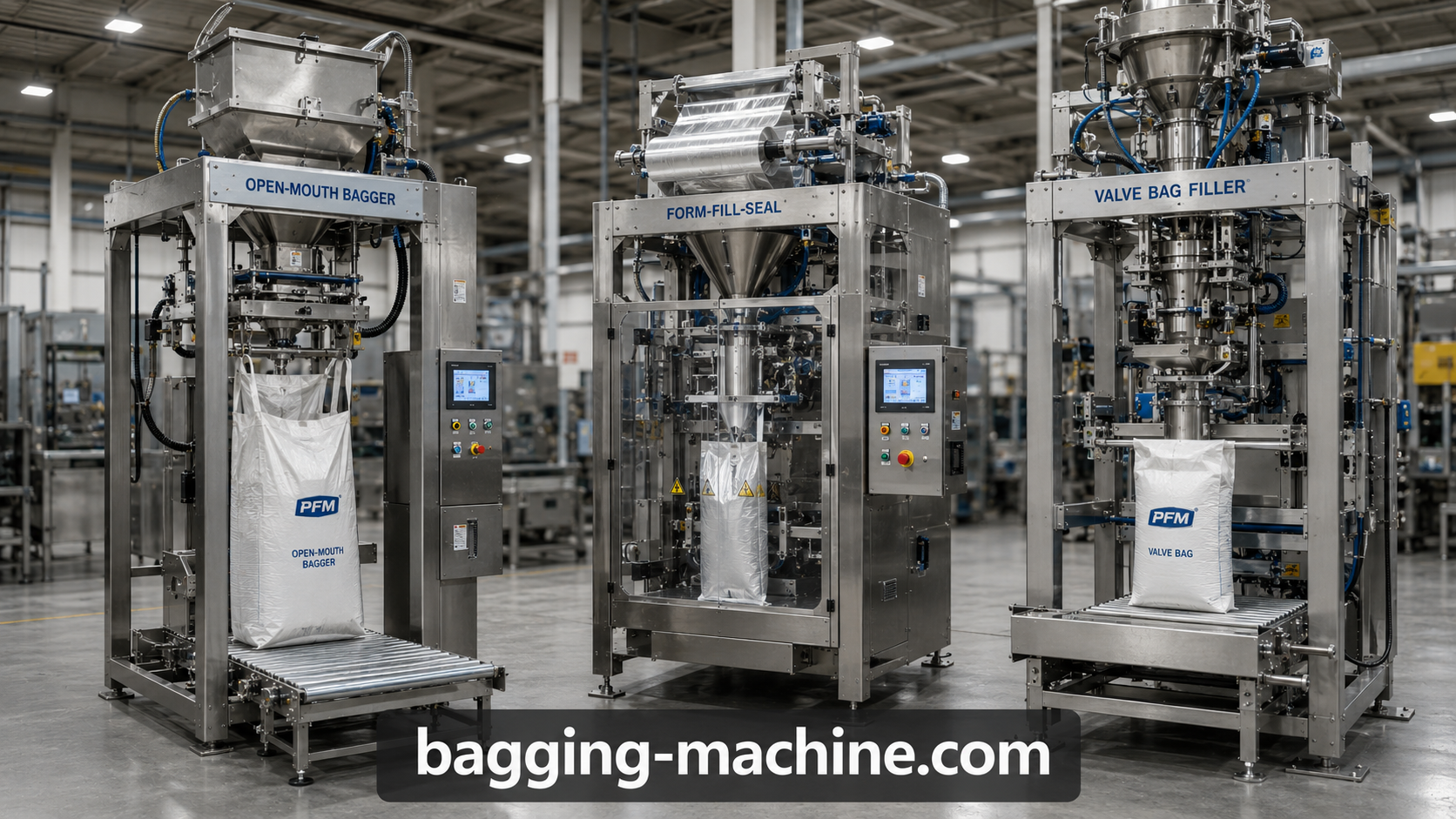
Choosing a bagging system without fully understanding your options is one of the most expensive mistakes a manufacturer can make. The wrong system — even a high-quality one — creates bottlenecks, incompatibilities, and maintenance headaches that cost far more than the price difference between machines.
The global packaging machinery market continues to grow as manufacturers across food processing, agriculture, chemicals, and e-commerce face increasing pressure to move product faster, reduce waste, and meet tighter regulatory standards. Bagging systems sit at the heart of this shift.
This guide is built for procurement teams, operations managers, and plant engineers who want a clear, honest reference before they begin conversations with suppliers. We cover every major system type, how they actually work, and the criteria that separate a good investment from a regrettable one.
What Is a Bagging System?
A bagging system is an integrated packaging solution that takes a product — whether granular, powdered, solid, liquid, or a mix — and delivers it into a bag in a controlled, repeatable, and scalable way. It encompasses every step from the moment product enters the machine to the moment a filled, sealed bag exits ready for downstream handling.
It is important to distinguish a bagging system from a standalone bagging machine. A machine is a single unit. A system includes all the interconnected components that make consistent, high-speed bagging possible: the infeed conveyors, the weighing or measuring equipment, the filling station, the sealing mechanism, and the discharge conveyor that feeds into checkweighers, labelers, or palletizers.
Where a bagging system fits in your broader packaging line matters enormously. It is the bridge between production and finished goods — and when it underperforms, every step downstream suffers.
5 Main Types of Bagging Systems Explained
Not all bagging systems are built alike. The right type depends on your product, your bag format, and your throughput requirements. Here are the five main categories you will encounter.
1. Open-Mouth Bagging Systems
Open-mouth systems fill pre-made bags that are presented to the machine with their top open. The bag is placed — manually or automatically — onto a filling spout, product is discharged and weighed, and the bag is then conveyed to a separate sealing station for heat sealing or sewing.
Best for: granular products like grains, seeds, sugar, salt, pet food, and fertilizers. Bag materials include woven polypropylene, paper, and polyethylene. Speed range typically falls between 3 and 25 bags per minute depending on automation level.
2. Pre-Made Pouch Bagging Systems
These systems take pre-formed pouches — stand-up pouches, flat-bottom bags, gusseted bags — from a magazine and fill them automatically. They are popular in consumer-facing food and beverage applications where shelf appearance and resealable features matter.
Best for: snack foods, coffee, spices, protein powders, and liquid-inclusive products. Output speed ranges from 20 to 80+ pouches per minute on high-speed lines. The trade-off is higher cost-per-bag since pre-made pouches are more expensive than roll-stock film.
3. Form-Fill-Seal (FFS) Systems
FFS machines create the bag from a flat roll of film, fill it, and seal it — all in one continuous process. Vertical FFS (VFFS) handles free-flowing products from above. Horizontal FFS (HFFS) handles solid or delicate products fed in from the side.
Best for: snacks, frozen foods, coffee, and any application where speed and film cost efficiency are priorities. VFFS machines are among the most widely used bagging systems globally, capable of 60 to 200+ bags per minute on high-output lines.
4. Valve Bag Filling Systems
Valve bags have a small self-closing valve built into a corner of the bag. The filling spout inserts into the valve, product is discharged under pressure or gravity, and the valve closes naturally once the spout is withdrawn — no separate sealing step required.
Best for: cement, chemicals, flour, starch, and other fine powders where dust containment is critical. The sealed valve design makes these bags particularly suited to products that need moisture protection and neat stacking on pallets.
5. Tabletop and Benchtop Bagging Systems
Compact bagging systems designed for low-to-medium volume operations where floor space is limited. They sit on a workbench or small frame and are typically semi-automatic — the operator presents the bag, the machine handles weighing and sometimes sealing.
Best for: specialty food producers, small manufacturers, start-ups, and operations with diverse SKUs that require frequent product changeovers. Output is lower (3 to 10 bags per minute), but the investment is significantly more accessible.
How Automated Bagging Systems Work — Step by Step
Understanding the internal mechanics of a bagging system helps you ask better questions when evaluating suppliers and diagnose problems faster once you are operational. Here is the complete process flow in a typical automated setup.
Step 1 — Product infeed. Raw product enters the system via a hopper, silo, or upstream conveyor. An infeed mechanism — screw auger, vibratory feeder, or belt conveyor — meters product into the machine at a controlled rate, preventing surges that would disrupt accuracy downstream.
Step 2 — Weighing or measuring. This is the accuracy-critical step. Net-weight scales weigh product in a suspended bucket before releasing into the bag. Volumetric fillers measure by volume rather than weight — faster, but less accurate for products with variable density. Multi-head combination weighers (used in snack and produce applications) simultaneously weigh multiple product portions and combine them to hit a target weight with exceptional speed and precision.
Step 3 — Bag presentation. On semi-automatic systems, an operator places the bag on the filling spout. On fully automatic systems, a bag magazine or roll-stock film feeds bags into position without human intervention. Bag clamps or vacuum grippers hold the bag open during filling.
Step 4 — Product filling. The weighed or measured product is discharged into the bag. Depending on the product and system type, this may happen via gravity drop, pneumatic transfer, or auger-driven discharge. Dusty or fine products often use enclosed spouts with dust extraction to protect the working environment and prevent product loss.
Step 5 — Sealing. The filled bag is sealed at the top. Heat sealing fuses thermoplastic materials together. Impulse sealing is suitable for thinner films. Ultrasonic sealing works with contaminated seal areas (useful when product residue is present on the seal zone). Sewing is used for paper and woven bags in agricultural and industrial applications.
Step 6 — Discharge and downstream handling. Sealed bags are deposited onto an output conveyor. From here they typically pass through a checkweigher (to reject out-of-spec bags), a metal detector or X-ray system (for food safety), a label applicator, and finally a palletizer or manual stacking station.
Each of these steps can be tuned, upgraded, or replaced independently — which is why a modular system architecture is worth prioritising when you evaluate equipment.
Manual, Semi-Automatic, and Fully Automatic: A Side-by-Side Look
Selecting your level of automation is the single most consequential decision in your bagging system purchase. Getting this wrong in either direction is costly — underbuying means you outgrow the equipment quickly, while overbuying means you are servicing debt on capacity you cannot utilise.
| Manual | Semi-Automatic | Fully Automatic | |
| Output (bags/hr) | 60–180 | 180–720 | 900–7,200+ |
| Operators required | 2–3 per station | 1 per machine | Supervisory only |
| Fill weight accuracy | Low (operator-dependent) | High | Very high |
| Upfront cost | Lowest | Moderate | Highest |
| SKU flexibility | Very high | High | Moderate |
| Best for | Very low volume, diverse products | Growing SMEs, seasonal ops | High-volume, consistent SKUs |
For most small and mid-size manufacturers, the practical entry point is a semi automatic bagging machine. It dramatically reduces the operator burden compared to manual bagging, delivers consistent fill weights, and does so at a capital investment level that generates a measurable return within a realistic timeframe. As volumes grow, the transition to fully automatic equipment becomes easier because operators are already familiar with automated workflows and the upstream/downstream infrastructure is largely in place.
For businesses researching the full spectrum of available configurations — from entry-level semi-automatic units to high-speed fully automatic production lines — exploring the complete bagging machine range is a practical starting point to understand what is available across different price points and application types.
7 Critical Factors When Buying a Bagging System
These are the criteria that separate a well-matched investment from an expensive mistake.
1. Product type and physical characteristics. The single most important factor. Flowability, particle size, density, moisture content, abrasiveness, and hazard classification all determine which filling technology is appropriate. Always provide detailed product data sheets to your supplier before any quotation is issued.
2. Bag material and format. The machine must be compatible with your specific bag type — not just your current bag, but any format you might adopt over the equipment’s lifetime. Switching bag suppliers later should not require a machine modification.
3. Fill weight range. Systems are optimised for a specific weight range. A machine calibrated for 1 kg to 5 kg bags will not perform accurately at 25 kg. Define your minimum and maximum fill weights clearly, and confirm accuracy specifications (typically expressed as ±X grams or ±X% of target weight) for the full range.
4. Required throughput. Calculate your realistic bags-per-hour requirement based on your longest single-SKU production run, then add a 25% capacity buffer. Machines consistently running at or above rated capacity degrade faster and create reliability risk.
5. Footprint and facility constraints. Measure your available floor space carefully, including ceiling height for vertical FFS machines and access requirements for maintenance. Also assess power supply (voltage, phase, amperage), compressed air availability, and dust extraction infrastructure.
6. Integration with existing equipment. A bagging system that cannot communicate with your checkweigher, labeler, or ERP system creates manual data entry and traceability gaps. Confirm what communication protocols the machine supports — most modern systems use standard PLC interfaces and can integrate with SCADA platforms.
7. Support, warranty, and spare parts. This is where many buyers underinvest in due diligence. Ask specifically: Where are your service engineers based? What is the typical lead time for critical spare parts? Do you offer remote diagnostics? What is covered under the standard warranty and for how long? The answers to these questions will matter far more than the machine’s brochure specifications at 2 AM when a seal jaw fails mid-production.
Common Mistakes Buyers Make (and How to Avoid Them)
Even experienced procurement teams fall into these traps.
- Undersizing on capacity. Buyers frequently spec a machine based on current volume rather than 18-to-24-month projected volume. The result is a system that is already struggling within a year of installation. Always buy for where your business is going, not where it is today.
- Ignoring bag material compatibility. A machine rated for polyethylene bags may not handle kraft paper or woven polypropylene without modification. Bag format decisions and machine decisions need to be made in parallel, not sequentially.
- Skipping the site assessment. Reputable suppliers will visit your facility before finalising a quotation. If a supplier is willing to sell you a machine without understanding your floor layout, product flow, and utility infrastructure, treat that as a warning sign. A site assessment protects both parties.
- Choosing on price alone. The cheapest machine that meets your specs on paper is rarely the lowest-cost option over a five-year period. Factor in energy consumption, consumable parts costs, mean time between failures, and the cost of unplanned downtime when comparing bids.
- Neglecting operator training. Even highly automated systems require trained operators for setup, changeovers, and first-line troubleshooting. A machine delivered without a structured training programme will underperform for months while your team figures things out through trial and error.
Conclusion
A bagging system is not a commodity purchase. It is a long-term operational commitment that affects throughput, product quality, labor costs, and customer satisfaction every single day it runs.
The manufacturers who make the best bagging system investments share a common approach: they define their requirements precisely before they speak to suppliers, they evaluate total cost of ownership rather than sticker price, and they treat after-sales support as a non-negotiable criterion rather than an afterthought.
Use this guide as your reference framework. Take it into supplier conversations. Ask the hard questions early. The right bagging system — matched correctly to your product, your volume, and your facility — will be one of the highest-return investments your operation makes.
Use up and down arrow keys to resize the meta box pane.