
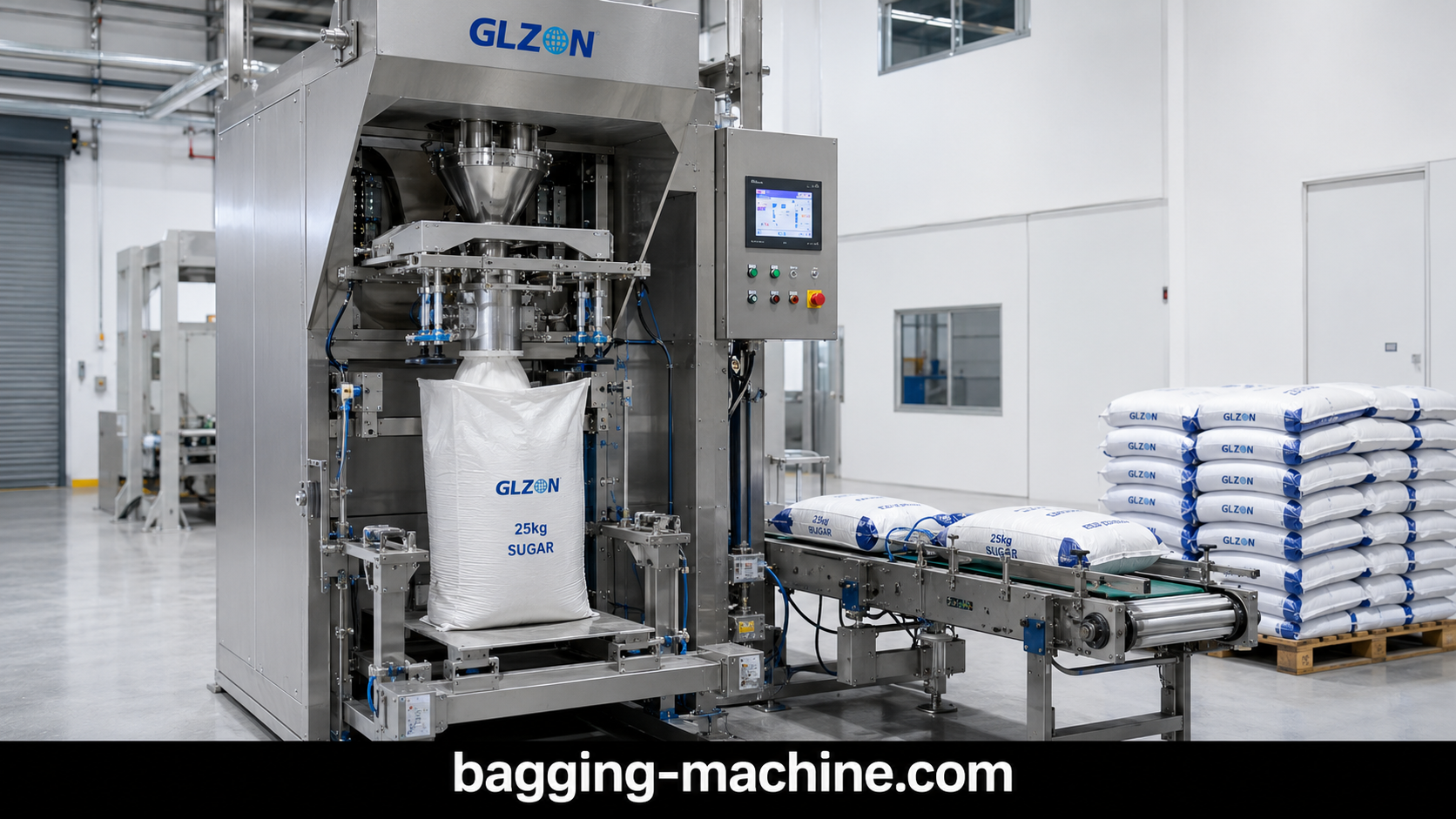
What Is an Open Mouth Bagging Machine?
An open mouth bagging machine is industrial packaging equipment that fills pre-made bags — with an open top — with bulk dry or semi-dry materials, then seals the filled bag by stitching, heat sealing, or gluing the open end closed.
It is one of the most widely used bag filling formats in the world — compatible with:
- Woven polypropylene (PP) bags
- Multi-wall paper bags
- Polyethylene (PE) bags
- Laminated and coated bag materials
Typical fill weight range: 5 kg to 50 kg per bag Typical throughput: 5 to 120 bags per hour depending on automation level
How Is an Open Mouth Bag Different from a Valve Bag?
This is the first question most buyers ask. Here is the core difference:
| Feature | Open Mouth Bag | Valve Bag |
| Bag opening | Full open top | Small self-sealing valve port |
| Filling method | Fill spout enters open top | Fill spout inserts into valve |
| Sealing method | Stitch, heat seal, or glue after filling | Valve self-seals under product pressure |
| Best material type | Granules, coarse powders, seeds, aggregates | Fine powders (cement, gypsum, chemicals) |
| Dust control | Moderate (fill head seals to bag mouth) | Excellent (fully enclosed during fill) |
| Bag cost | Lower | Higher |
| Flexibility | High — easy to use different bag sizes | Lower — bags must match valve spec |
Bottom line: Open mouth bags suit free-flowing granular products in standard bag formats. Valve bags suit fine powders where dust control is critical.
How an Open Mouth Bagging Machine Works — Step by Step
Understanding the fill cycle helps you evaluate any system and train operators effectively.
Step 1 — Bag magazine / bag supply
- Pre-made bags are loaded into the machine’s bag magazine (a stack holder)
- On automatic systems, a bag pick-and-place mechanism separates and positions one bag at a time
- On semi-automatic systems, the operator manually places each bag onto the fill spout
Step 2 — Bag opening
- Suction cups or air jets open the bag mouth fully
- The bag is positioned squarely under the fill spout
- Proper opening is critical — a partially open bag causes spillage and inaccurate fills
Step 3 — Bag clamping
- The open bag mouth is clamped firmly to the fill spout
- The clamp creates a dust-tight seal between the bag and the machine during filling
- On enclosed systems, a dust extraction connection captures any fine particles that escape
Step 4 — Weigh-fill cycle
- Material flows from the hopper through the fill spout into the bag
- A weighing system (gross weigh or net weigh) controls the fill quantity
- Gross weigh: The entire bag + product is weighed on a platform scale below
- Net weigh: Product is weighed in a weigh hopper above, then released into the bag
- Net weigh is more accurate for fine or inconsistent-density materials
Step 5 — Fill shutoff
- When target weight is reached, the fill valve closes automatically
- A dribble feed rate in the final stage improves weight accuracy
- Typical accuracy: ±0.2% to ±0.5% of target weight
Step 6 — Bag release and sealing
- The clamp releases the filled bag
- The bag moves to the sealing station via conveyor
- Sealing options:
- Stitching — most common for woven PP bags; fast and secure
- Heat sealing — for PE or laminated bags; creates a hermetic closure
- Gluing — for multi-wall paper bags; clean appearance for retail
Step 7 — Discharge
- Sealed bags discharge onto a takeaway conveyor
- Bags are then palletized manually, semi-automatically, or by robotic palletizer
Types of Open Mouth Bagging Machines
There are three main configurations — the right one depends on your throughput, budget, and level of automation needed.
1. Manual Open Mouth Bagger
- Operator places each bag by hand, holds it during filling, then moves it to sealing
- Minimal automation — the machine only controls fill weight
- Throughput: 3–8 bags/hour
- Best for: Very low volume, startup operations, trial production runs
- Cost: Lowest entry point
2. Semi-Automatic Open Mouth Bagging Machine
- Operator places the bag on the fill spout; the machine handles filling, weighing, and signals for removal
- Filling and weighing are fully automated; bag placement and sealing may be manual or semi-automated
- Throughput: 5–20 bags/hour
- Best for: Small-to-medium operations, multiple SKUs, mixed bag sizes
- Cost: Mid-range
3. Fully Automatic Open Mouth Bagging Machine
- Fully automated from bag pick to filled-bag discharge
- Bag magazine feeds bags automatically; suction opens bags; automated clamp, fill, weigh, seal, and conveyor discharge
- Throughput: 20–120 bags/hour
- Best for: High-volume single or multi-product operations with consistent bag sizes
- Cost: Higher capital — pays back through labor savings and throughput gains
Key Industries That Rely on Open Mouth Bagging Machines
Open mouth bagging machines are used across virtually every industry that packages dry bulk material in standard bag formats.
Food Processing
- Products: Rice, sugar, flour, salt, dried beans, pasta, breakfast cereals, animal crackers, pet food
- Bag types: Woven PP with PE liner (moisture barrier), multi-wall paper, laminated PE
- Key requirements: Food-grade stainless steel contact surfaces, hygienic design, easy cleanability between SKUs
Agriculture
- Products: Seeds, grains, dried corn, fertilizer blends, soil amendments, animal feed
- Bag types: Woven PP bags (20–50 kg), multi-wall paper bags
- Key requirements: High throughput during harvest seasons, robust construction for dusty environments
Construction and Building Materials
- Products: Sand, gravel, dry mortar mix, tile adhesive, ground calcium carbonate, recycled aggregates
- Bag types: Heavy-duty woven PP bags (25–50 kg)
- Key requirements: Abrasion-resistant fill spout and hopper, dust control, high fill rates for coarse heavy materials
Chemicals
- Products: Non-hazardous chemical granules, salt, soda ash, sodium bicarbonate, plastic pellets
- Bag types: Woven PP, laminated bags for moisture-sensitive products
- Key requirements: Weight accuracy for batch costing, dust containment at fill head, compatibility with corrosive or reactive materials
Animal Feed and Pet Food
- Products: Pelleted feed, meal, mixed rations, kibble, dried pet food
- Bag types: Multi-wall paper, woven PP with printing for retail presentation
- Key requirements: Gentle fill to avoid pellet breakage, high throughput, clean presentation for retail-facing bags
Horticulture and Landscaping
- Products: Compost, bark mulch, topsoil, perlite, vermiculite, decorative aggregates
- Bag types: Heavy-duty woven PP or PE bags (20–50 kg)
- Key requirements: Handling of irregular, fibrous, or moist materials; robust sealing for outdoor retail bags
Open Mouth vs. Valve Bag: Which Format Suits Your Product?
Use this decision guide to determine which bag format is right for your material:
Choose an open mouth bag when:
- ✅ Your product is a coarse granule, pellet, seed, or aggregate
- ✅ You need a low-cost, widely available bag format
- ✅ You want flexibility to switch between bag sizes easily
- ✅ Your product does not produce excessive fine dust during filling
- ✅ You are packaging for retail or trade distribution (printed bags)
- ✅ Fill weight is between 5 kg and 50 kg
Choose a valve bag when:
- ✅ Your product is a very fine powder (cement, lime, gypsum, titanium dioxide)
- ✅ Dust containment is a regulatory or safety requirement
- ✅ You need very high-speed filling (1,000–3,000+ bags/hour on rotary packers)
- ✅ The self-sealing closure suits your distribution chain
- ✅ Your product has a high market value where giveaway must be minimized
How to Integrate an Open Mouth Bagging Machine into Your Production Line
A standalone open mouth bagger is only part of a complete packaging line. Here is how it connects upstream and downstream:
Upstream Integration
- Material feed: Conveyor belt, bucket elevator, screw conveyor, or pneumatic transfer line feeds product into the machine’s hopper
- Hopper level control: Level sensors in the hopper trigger upstream feed to maintain consistent product supply without overflow
- Product conditioning: Screens, magnets, or scalpers upstream remove oversized particles or contaminants before the fill station
Downstream Integration
- Takeaway conveyor: Carries sealed bags away from the fill station at controlled speed
- Checkweigher: Inline weight verification — flags bags outside tolerance for rejection or rework
- Metal detector: Detects any metal contamination in filled bags before palletizing
- Bag flattener / former: Squares up filled bags for stable palletizing
- Palletizer: Manual stacking, semi-automatic layer palletizer, or robotic palletizer
- Stretch wrapper: Secures the pallet load for transport
An open mouth bagging machine integrated into a complete line — from upstream feed to downstream palletizing — creates a continuous, largely automated packaging operation that minimizes manual handling at every step.
Choosing the Right Automatic Bagging Machine for Open Mouth Applications
When specifying an open mouth bagging machine for your operation, evaluate these key factors:
Throughput Requirement
- Calculate required bags per hour from your daily volume and shift hours
- Add 20–25% headroom for downtime, changeovers, and future growth
- Match automation level to throughput: semi-auto under 20 bags/hour, fully auto above
Bag Size and Format Range
- What are your minimum and maximum bag dimensions (length × width)?
- Do you use multiple bag sizes? If so, how fast must changeover be?
- Are bags pre-printed? If yes, confirm the machine handles printed bags without marking
Material Characteristics
- Is your material free-flowing or does it need flow promotion in the hopper?
- Is it abrasive? (Specify abrasion-resistant fill spout and hopper liner)
- Is it dusty? (Specify enclosed fill head with dust extraction)
- Is it food-grade? (Specify stainless steel contact parts and hygienic design)
Sealing Method
- Stitching: Best for woven PP bags — fast, strong, easy to open at destination
- Heat sealing: Best for PE or laminated bags — hermetic, moisture-resistant closure
- Gluing: Best for paper bags — clean appearance for retail shelf presentation
Weight Accuracy Requirement
- ±0.2% or better for high-value food or chemical products
- ±0.5% is typically acceptable for aggregates and lower-value bulk materials
- Always ask for certified calibration data and reference fills on your material
Hygiene and Regulatory Requirements
- Food applications: stainless steel contact surfaces, IP65 or better electrical enclosures
- Chemical applications: ATEX classification if filling flammable materials
- Pharmaceutical: full containment, documentation, and validation support
A fully automatic bagging machine configured for open mouth applications delivers the highest throughput with the lowest labor cost per bag — but only when correctly specified for the material, bag format, and production volume.
Open Mouth Bagging Machine: Buying Checklist
Before finalizing any purchase, confirm:
- ✅ Machine rated for your required throughput (bags/hour) with headroom
- ✅ Compatible with your bag material (woven PP, paper, PE, laminated)
- ✅ Handles your full bag size range with fast changeover
- ✅ Fill weight accuracy specification meets your tolerance
- ✅ Sealing method matches your bag closure type
- ✅ Contact surfaces match your hygiene or material requirements
- ✅ Dust containment appropriate for your material and workplace regulations
- ✅ Upstream feed and downstream conveyor integration confirmed
- ✅ Supplier has filled your material type before (ask for references)
- ✅ Fill trial with your actual product completed before purchase
- ✅ Spare parts availability and lead times confirmed
- ✅ Training and installation support included in purchase agreement
Frequently Asked Questions
Q: What is the difference between an open mouth bagging machine and a Form Fill Seal (FFS) machine? An open mouth bagging machine fills pre-made bags supplied from a magazine. A Form Fill Seal machine creates the bag from a roll of film, fills it, and seals it in one continuous process. Open mouth machines are more flexible (different bag sizes and materials); FFS machines are faster for single-format, high-volume runs.
Q: Can an open mouth bagging machine handle moist or sticky materials? Some materials with low moisture content can be handled with appropriate hopper agitation. However, highly moist, sticky, or cohesive products often cause bridging and sealing problems. Always specify your material’s moisture content to the supplier and request a material trial.
Q: What bag weights can an open mouth bagging machine handle? Most open mouth baggers handle between 5 kg and 50 kg per bag. Some heavy-duty models extend to 60 kg. For fill weights above 50 kg, a bulk bag (FIBC) filling system is a more appropriate solution.
Q: How long does a bag changeover take on an automatic open mouth bagging machine? Changeover time varies by machine design. Well-designed automatic systems allow bag size changeovers in 15–30 minutes. Older or less flexible machines may require 45–90 minutes. Fast changeover is critical for operations running multiple SKUs.
Q: What sealing method is best for heavy-duty woven PP bags? Stitching is the most common and reliable sealing method for woven PP bags in industrial applications. It is fast, strong, and easy for end users to open at the destination. Heat sealing is preferred when a moisture-barrier closure is required.
Conclusion
An open mouth bagging machine is one of the most versatile and widely used pieces of packaging equipment in industrial manufacturing — handling everything from rice and sugar to sand, fertilizer, and animal feed across virtually every dry bulk industry.
Key takeaways:
- Open mouth machines suit granular, free-flowing materials in pre-made bag formats from 5–50 kg
- Three main types: manual, semi-automatic, and fully automatic — match to your throughput
- Proper integration upstream (feed) and downstream (conveyor, palletizer) turns a bagging machine into a complete packaging line
- Sealing method selection (stitch, heat seal, glue) must match your bag material and end-use requirements
- Always conduct a fill trial with your actual product before committing to a purchase
Whether you are packaging food ingredients, construction aggregates, chemical granules, or agricultural products, a correctly specified open mouth bagging machine removes the bottleneck from your packaging line and delivers consistent, accurate fills at scale.