
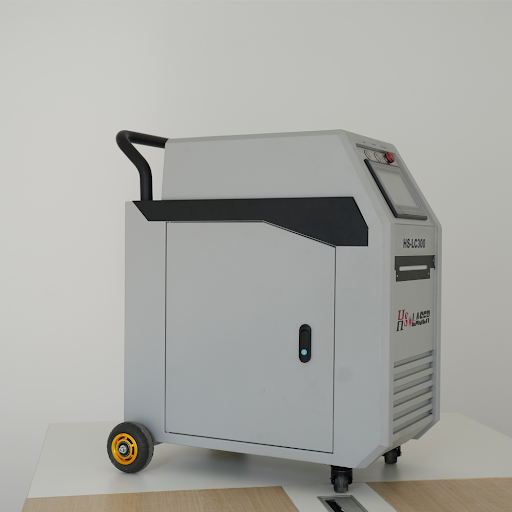
If you are shopping for industrial equipment, a list of technical parameters can look like a wall of numbers. Yet that list tells you whether a machine fits your workshop. This article reads through the specifications of the air cooled pulse laser cleaning machine published by HS Laser and explains each in plain words.
Models, power and electricity
The page lists three model numbers, HS-LC200, HS-LC300 and HS-LC500. They correspond to laser power of 200W, 300W and 500W, and the header also mentions a 1000W option. Whole machine power consumption is listed as 850W, 1300W and 2000W respectively. The power supply is single phase, accepting 110V and 220V with a tolerance of plus or minus 10 percent at 50 or 60 Hz.
The practical point is that a machine at the 500W level draws about 2000W from the socket. Check that your workshop wiring can supply that safely before you buy.
Laser source and wavelength
The laser type is described as pulse laser technology with a pulse type laser source. The wavelength is 1064 nanometers, plus or minus 5. This is a common wavelength for industrial fiber lasers. It is important for safety too, because eye protection must be rated for it.
Pulse energy, width and frequency
Pulse energy can be chosen from 1.5 mJ, 5 mJ, 15 mJ or 50 mJ options. The pulse width ranges from 13 to 500 nanoseconds, and the frequency from 1 to 4000 kHz. Together these control how the laser removes material. Higher pulse energy delivers a stronger hit per pulse, which suits thick rust or heavy paint. Lower energy is gentler, which suits delicate surfaces or thin films. The ability to adjust is helpful if you clean many different things.
Power can also be adjusted from 10 to 100 percent.
Beam delivery
The fiber core is 100 micrometers. The focus distance is listed as 100 or 160 mm, and the scan width as 90 mm or 145 mm depending on the lens option listed as F160 or F254. A wider scan covers more area per pass, but spreads the energy over more surface, so the best choice depends on the task.
The control system supports eight scan shapes. This lets the operator choose a pattern that matches the surface, for example a line or other shapes, for efficient coverage.
Cooling
The cooling system is air cooling. This keeps the equipment compact and avoids the need for a water chiller. Working temperature is listed as 0 to 40 degrees Celsius and humidity as 30 to 80 percent. The machine should be placed on a flat surface without vibration or impact, as the page notes.
Size and weight
The machine weighs 56 kg. The cleaning head weighs 0.7 kg and is moved by hand. The machine dimensions are listed as 830 by 380 by 820 mm, and the packing size is 930 by 480 by 920 mm with a packing weight of 76 kg. The suitcase style body is silver gray. These figures matter for shipping, storage and for moving the machine between work sites.
What it can clean
The company says the machine removes rust, paint, oil and dust. It also mentions resins, oxides and coatings. Industries listed include automotive, aerospace, mold maintenance and environmental protection. The company describes the laser head as having dual red guide lights for focus positioning, with an optional rotating screen for easier operation.
Packaging and logistics
Think about getting the machine to you. A packing weight of 76 kg is manageable for air or sea freight, but ask about packaging quality and how the machine is protected in transit. Ask also about spare parts, such as protective lenses, and how they will be supplied.
About EU standard
The product name mentions EU standard, but the technical parameters on the page do not list specific certificates. If you import the machine into a market that requires conformity marking or documents, request the exact declarations and test reports in writing. This is a normal step, and a serious supplier should be able to provide documents or explain clearly what applies.
Points to confirm before buying
Prepare a short list. Which model suits my parts and coatings? Can you provide a cleaning sample with my material? What is the warranty on the laser source? What training and manuals come with the machine? How do I contact support, and in which languages? The company offers contact by email, phone and messaging for plans and quotes.
Putting the numbers to use
Specifications are a guide, not a promise. Real cleaning speed depends on the type and thickness of contamination, the surface and operator technique. Use the numbers to shortlist a model, then confirm with a sample. With a clear picture of your own needs and a few test results, you can choose the right power level and avoid overspending.