
Choosing a packaging partner shouldn’t feel like roulette. Corrugated prices are up about 15 percent since mid-2024, and new EPR plus PPWR rules stack on pages of paperwork—yet most quotes still hide tooling, freight, duty, and reprint risk behind a shiny unit price.
This guide fixes that. You’ll get an eight-factor scorecard, a fill-in RFQ sheet, and nine suppliers matched to real-world use cases. Download the templates, compare apples to apples, and pick a partner with evidence—not guesswork.
Quick answer: how to compare packaging suppliers
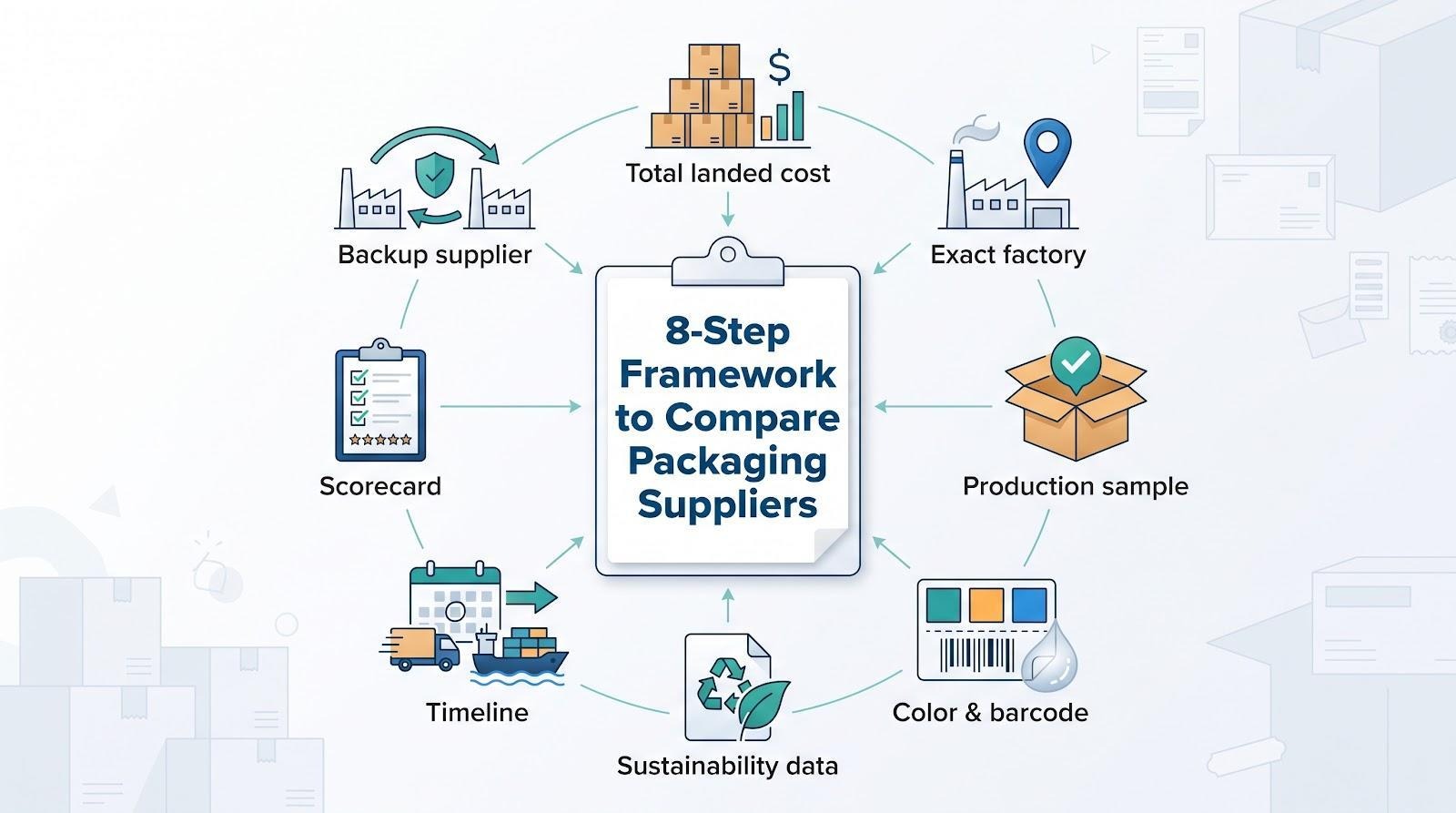
Give every contender the same written spec (dimensions, board grade, label stock, finish, and quantities) so the numbers line up. Then judge each proposal on eight proven factors that cover cost, quality, and risk:
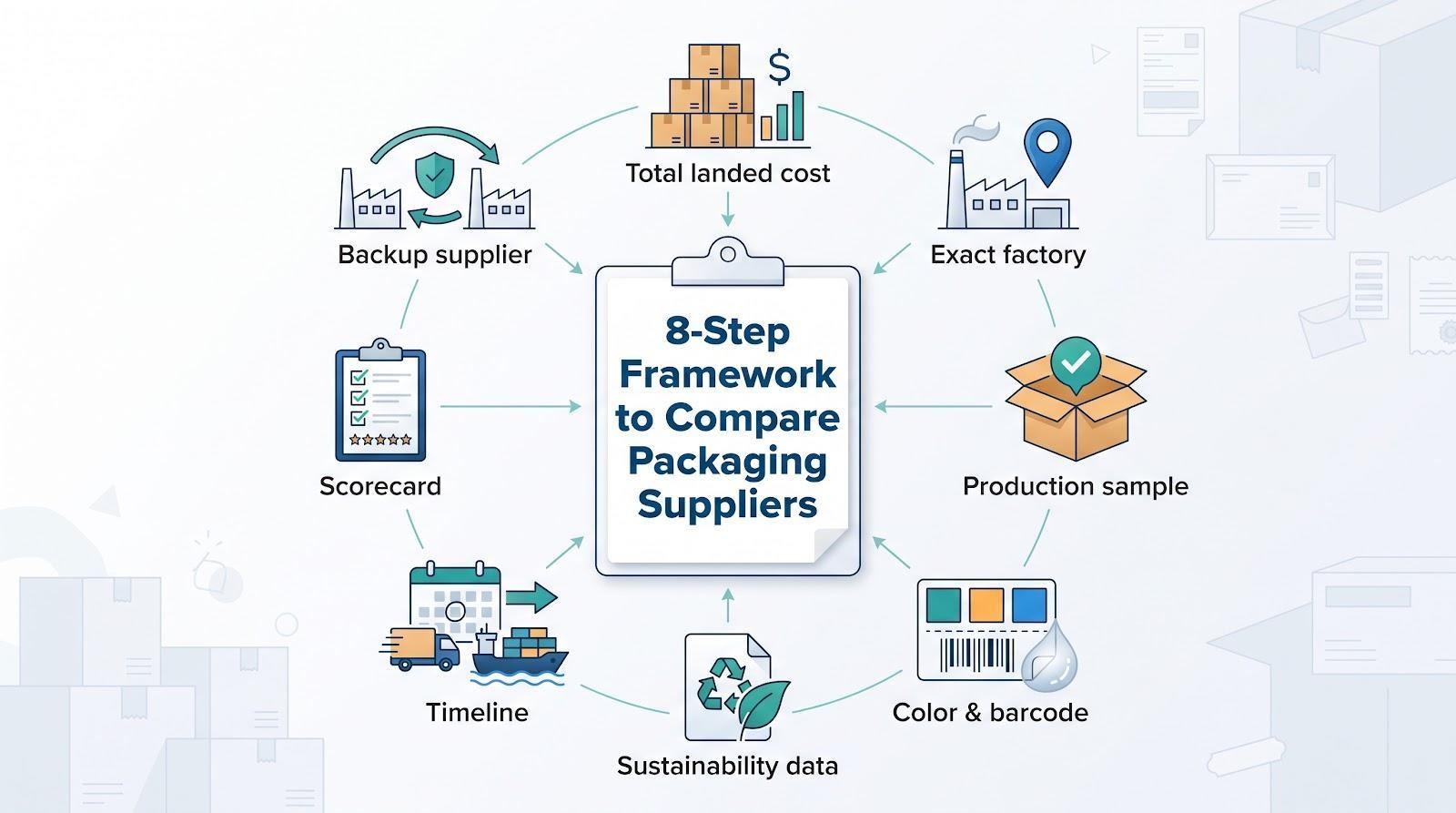
- Compare total landed cost (unit price + tooling + freight + duty).
- Confirm the exact factory slated to run your job.
- Approve a production-equivalent sample rather than a stock showpiece.
- Check color, barcode, and adhesive against written tolerances.
- Collect order-specific sustainability data (FSC code, PCR percent, EPR weight).
- Map the timeline from artwork lock to delivery, customs included.
- Apply the eight-factor scorecard that follows.
- Designate a qualified backup supplier for resilience.
Follow these steps, and whether you’re buying a thousand mailers or planning a global rollout, decisions rest on evidence, not guesswork.
Normalize the packaging specification before requesting quotes: define the complete packaging BOM
A supplier can only hit the target you hand over. Leave gaps and every vendor will guess differently, making your quotes impossible to compare.
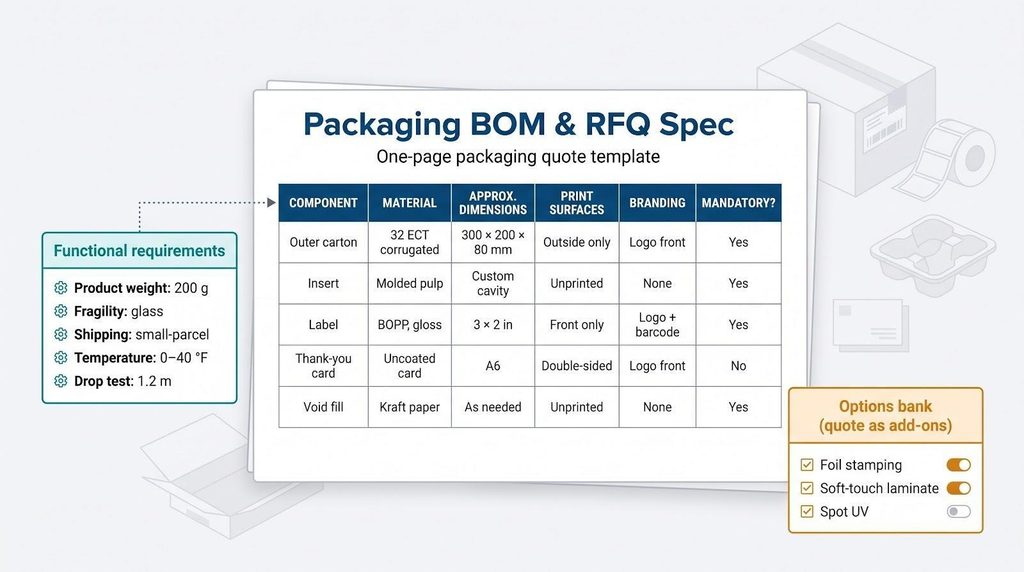
Start with a one-page bill of materials (BOM) listing every component the customer will touch, from the outer carton to the thank-you sticker. For each line, note material, rough dimensions, print surfaces, and whether branding is mandatory. When every bidder sees the same data, those “surprise” line items vanish.
Specify functional requirements
Numbers turn a parts list into engineering guidance. Record product weight and fragility, the shipping route (pallet, small-parcel, or both), and any environmental extremes. Write targets in plain figures: “label must hold at 0–40 °F,” “insert must restrain a 200 g glass bottle after a 1.2 m drop.” Suppliers can now match materials and tests on the first try, saving days of back-and-forth.
Separate non-negotiables from optional finishes
Lock the essentials: structural strength, regulatory text, scannable codes. Everything decorative (foil, soft-touch, spot UV) goes in an options bank that suppliers quote as add-ons. Seeing the price delta in black and white makes trade-offs painless.
Identify the supplier’s business model
- Direct manufacturer – owns presses and die-cutters; great control, higher MOQs.
- Broker or distributor – one contact, multi-plant sourcing; ask which site prints each component.
- Web-to-print platform – instant quotes for standard SKUs; less fit for custom inserts or ISTA tests.
- Managed global partner – engineering + vetted offshore plants; longer onboarding, big-project muscle.
- Specialist converter – labels, flexibles, or protective foam only; pair with a box generalist for full kits.
Ask each contender to name the producing facility and spell out hand-offs from sale to loading dock. That clarity prevents finger-pointing later.
How the nine packaging suppliers were scored
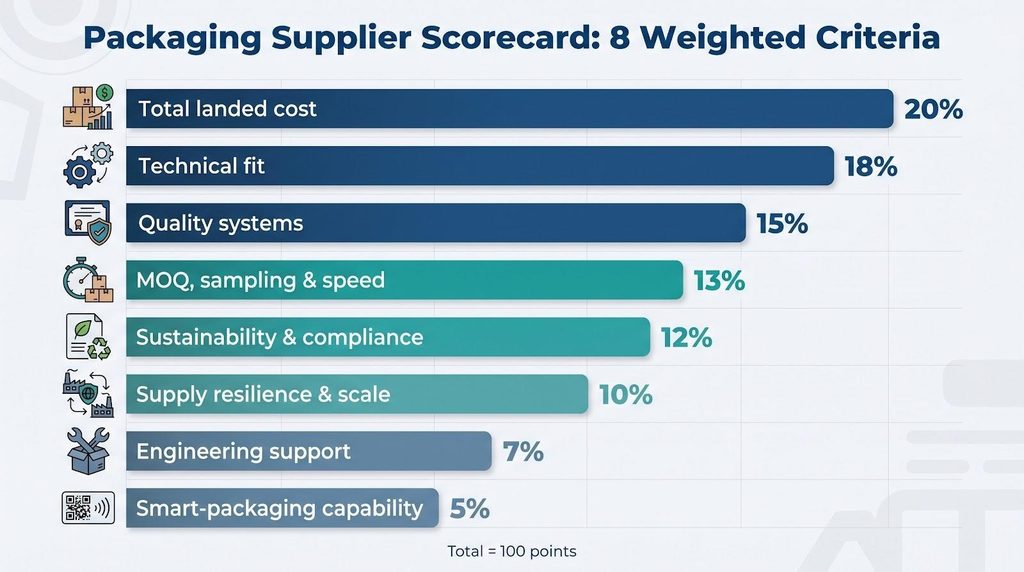
Every candidate ran through one eight-factor scorecard: no dart-throwing, just numbers. Each factor was rated 1–5 and multiplied by its weight for a 100-point total. Tie breakers applied only when two suppliers landed within two points.
| Criterion | Weight | Why it matters |
| Total landed cost | 20 percent | Tooling, freight, and duty often outweigh unit price |
| Technical fit | 18 percent | Boxes, inserts, and labels must share tolerances and surface chemistry |
| Quality systems | 15 percent | G7, GMI, or ISO at the actual press hall prevent costly reprints |
| MOQ, sampling & speed | 13 percent | Fast only counts when inventory and golden samples align |
| Sustainability & compliance | 12 percent | PPWR paperwork and U.S. EPR fees now hit the balance sheet |
| Supply resilience & scale | 10 percent | Dual-plant capacity kept brands shipping during 2026 freight shocks |
| Engineering support | 7 percent | Structural tweaks and change control save downstream costs |
| Smart-packaging capability | 5 percent | Variable QR or NFC may be optional today but future-proofs tomorrow |
With the yardstick set, the next section shows how each supplier measured up.
1. Zenpack: best for engineered consumer-electronics packaging
Zenpack starts every brief with one question: What problem are we solving? The answer surfaces in exploded-view mock-ups, drop-test videos, and color drawdowns that your Zenpack packaging partner turns into a single design-to-delivery workflow, balancing protection, presentation, and sustainability for every device.
Industrial designers work beside packaging engineers, so strength and shelf appeal arrive together. On one recent headset project the team shaved 2 mm off an insert wall to meet airline volumetric limits, then verified the change with ISTA shock data rather than gut feel.
Print control is tight. The assigned press halls carry current G7 and GMI certificates, a must when the same CMYK gradient spans carton board and gloss BOPP labels.
Sampling follows a three-step cadence: blank fit test, printed prototype, golden sample. The extra days up front avoid six-figure reprints later.
Pricing is RFQ-only, yet electronics brands report Zenpack sits in the premium-mid cost tier once tooling, freight, and duty are included. MOQs flex with complexity: molded-fiber inserts often start near 5,000 pieces; simple corrugated pilots can run at 1,000.
Program management is the real edge. With mirrored partners in California and Shenzhen, Zenpack can launch domestically this quarter and duplicate overseas the next under a single change-control log, which is one reason NVIDIA chose the firm for its SHIELD tablet packaging.
Ask early about lead time and regional plug variations. Once the spec is locked, Zenpack delivers assemblies that survive transit, delight unboxings, and meet color standards your creative team can sign without squinting.
2. PackMojo: best for lower-MOQ international launches
PackMojo turns custom-box pricing into a three-click exercise, with no sales call and no PDF lag. That speed, plus MOQs that start in the low hundreds, makes it a favorite for Kickstarter pilots and regional tests.
Behind the interface sits a vetted network of factories across Southeast Asia and China. The reach keeps setup costs low and options wide, from E-flute mailers to rigid neck boxes. Internal printing, soft-touch laminate, and other upgrades appear as on-screen toggles, not mystery surcharges.
Lead time is quick for an offshore model: production often takes 12–16 days after artwork approval, with sample kits shipping sooner. Freight is the swing factor; ocean saves cash but adds weeks, while air does the opposite, so PackMojo shows side-by-side landed costs (duties included).
Quality follows the self-serve rhythm: approve a 3D digital proof, then a physical prototype if color or fit is critical. Because G7 compliance varies by partner plant, request the certificate covering the exact press hall before locking artwork.
Lock your Incoterm (DDP vs. FOB) before paying, and budget a 7–10-day customs buffer for ocean freight. Follow that checklist and PackMojo lets you launch, learn, and iterate without filling the warehouse.
3. PakFactory: best for complex premium packaging
PakFactory is where branding teams turn “unboxing” ideas into manufacturable specs—think telescoping rigid boxes in linen paper, inserts that lift a serum bottle at the right angle, and magnetic lids that click shut with certainty.
A dedicated project manager leads structural engineers, print technicians, and logistics planners. Share a CAD file (or a napkin sketch) and you’ll receive dielines, finish swatches, and a candid discussion of features that add cost without adding perceived value.
Production spans North America and Asia. Many jobs launch offshore for economy, then migrate to a domestic press once volume and turnaround trump pennies. Because the team identifies the exact plant and press model, you can request matching G7 or ISO certificates before approval.
Sampling is staged: blank white fit mock-up, printed prototype for brand sign-off, and a full-finish mock if foil or spot UV enters the mix. Each sample carries a fee, but skipping one risks color shift on textured stock that no post-edit can fix.
MOQs hover around 1,000 for folding cartons and 500 for premium rigid boxes. Tooling for magnetic lids or neck trays is quoted separately so you can amortize it over forecast rather than absorb it in the first order.
Choose PakFactory when visual theatre and structural precision drive product value. Lock artwork early, because every foil plate or emboss-die tweak after approval resets both timeline and budget in ways finance will notice.
4. Packlane: best for transparent self-serve box ordering
Need a quote in seconds? Enter your dimensions in Packlane’s online designer and a live price appears, ideal for marketers testing new SKUs or fresh artwork without PO paperwork.
The 3-D tool shows cost drivers in real time: trim a quarter-inch, switch from white to kraft, watch the unit price drop. That instant feedback teaches budget levers faster than any webinar.
Default production runs on digital presses, so you can order full-color CMYK prints with MOQs as low as a single box. Orders that climb into the low thousands can shift to offset or litho-lam without changing platforms.
Lead times are predictable: about 10 business days standard or 7 with rush, plus UPS or FedEx transit. Need it tomorrow? Pay the surcharge and Packlane will oblige.
Know the limits. The catalog stops at mid-size mailers and folding cartons; magnetic rigid boxes, engineered inserts, or shrink sleeves need a specialist. Digital color control is solid but not a full G7 workflow, so ask for a printed drawdown and agree on a Delta E tolerance if your brand hinges on Pantone accuracy.
Choose Packlane when speed, clarity, and small-to-medium volumes beat luxury embellishments. Launch, learn, iterate, with no pallet space required.
5. UPrinting: best accessible one-stop online option
UPrinting gives small teams one storefront for boxes, roll labels, brochures, and even insert cards, handy when brand consistency matters more than juggling four vendors.
Quoting is straightforward. Enter a quantity, say 250, and the site shows per-unit pricing, upgrade toggles, and a production window. Custom mailers usually ship 10–15 business days after proof approval; roll labels often leave the plant within a week.
Proofing uses two safeguards: an online preview for bleed, trim, and resolution, followed by a human pre-press check that catches thin barcode quiet zones or fold-line text. Many template-only platforms skip that second look.
Because production spans several U.S. plants, ask whether your box and label will print under the same roof. Single-site output minimizes color drift; if split, agree on a Delta E tolerance before approving artwork.
Engineering support is light; you won’t find a packaging engineer ready to debate stacking strength (ECT vs. BCT). For straightforward SKUs that’s fine; if you sell oil-heavy cosmetics or fragile glass, a specialist may still be wiser.
With MOQs starting at a single box on select styles, UPrinting lets you test new artwork with little risk. Unit cost rises as quantity falls, yet often stays below the short-run prices of a traditional offset house.
Choose UPrinting for predictable lead times, a U.S. production footprint, and all-in-one convenience. Keep highly engineered structures elsewhere and the partnership shines.
6. Great Little Box Company: best integrated regional option
Great Little Box Company (GLBC) grew up serving Pacific Northwest brands that wanted big-converter capability without cross-border headaches. The formula still works: broad product menu, tight geography, and people who answer the phone.
Under one roof you’ll find corrugated converting, folding cartons, labels, flexible pouches, and protective foam. One color standard and one logistics plan mean fewer “who owns this?” emails.
Plants in British Columbia and Washington State keep West Coast lead times in the 12–18 business-day window once artwork is locked. Finished goods cross the border, so U.S. buyers avoid raw-material customs entries.
MOQs flex by process: digital drops to a few hundred, while flexo or litho starts near 1,000. Quotes break out tooling and plate costs so finance can amortize them cleanly.
Quality is plant-specific. Ask which site will run your SKU, and request that location’s FSC chain-of-custody code plus its food-contact or in-line barcode-verification cert PDF.
Choose GLBC when you need multiple components to arrive together and value a regional partner who can attend a line trial in person. If your 3PL sits on the West Coast, the freight savings alone can fund a few foil extras.
7. Smurfit Westrock: best for enterprise scale
Few converters own mills, design labs, and recycling loops on several continents; Smurfit Westrock does, turning raw fiber into finished displays under one corporate umbrella.
Need identical litho-lam shelf trays in Ohio and Valencia? The team mirrors die profiles, ink formulas, and board calipers, helping large buyers hit over 95 percent on-time-in-full once forecasts settle.
Engineering support shows up early. Specialists model pallet compression, then tweak flute direction to shave grams without hurting edge-crush strength. Because the company controls its own pulp and recycling streams, it can supply exact post-consumer content percentages and EPR-ready weight tables, not marketing averages (ask for the mill certificate with your quote).
Economics favor volume. Pilot runs under 5,000 units trigger setup surcharges, but annual demand past six figures often beats brokered prices by pennies that add up fast.
Agility is the trade-off. Change requests route through plant schedulers and corporate QA, so lock specifications early. If your launch shifts weekly, expect paperwork. For high-volume programs that must survive global freight, hold color across regions, and meet PPWR or California SB 54 reporting, the muscle is worth the bureaucracy.
8. Arka: best for eco-oriented e-commerce brands
At Arka, sustainability comes standard: recycled-kraft board, soy inks, and optional carbon-neutral shipping appear on the configurator before you see a price.
The ordering flow matches Packlane’s speed but adds a green overlay. Toggle “Eco,” and the tool suggests higher post-consumer-fiber stocks, water-based coatings, and then previews the curbside-recyclable icon your customers expect.
Entry point is low, MOQ about 50 mailers, ideal for a Shopify drop. Unit cost is higher at that scale, yet flat-rate freight and duties are built into DDP checkout for U.S. addresses, so no surprise brokerage bill later.
Lead with documentation. Arka lists FSC or SFI numbers online; still request the chain-of-custody PDF for the plant that will run your job, plus any compostability certificate. Ask the carrier for the carbon-offset program name and tonnage applied to your shipment.
Color control relies on calibrated digital presses in U.S. and Canadian partner plants, perfect for kraft-on-kraft and muted palettes. Need high-gloss metallics or seven-color photorealism? A specialist press will serve you better.
Choose Arka when your audience demands recycled-content disclosure and your volumes sit between 50 and approximately 2,000 units. Pair the boxes with a locally printed pressure-sensitive label if you need specialty adhesives, and you’ll ship green without the guesswork.
9. Resource Label Group: best for technical and connected labels
A single bad label can halt a production line; RLG’s job is to prevent that. More than 20 specialized plants across North America cover everything from 1.2 mil BOPP for high-speed beverage lines to heat-shrink sleeves with distortion-compensated art, and NFC-embedded labels for connected-packaging campaigns. One program manager can shepherd both pressure-sensitive SKUs and serialized QR sleeves.
Quality is documented, not assumed. Plants hold ISO 9001, GMI, and in-line vision inspection; ask your rep for the latest audit matrix from the specific site assigned to your order.
Lead time hinges on complexity: stock constructions ship in about 5 business days after art approval, while custom laminations or embedded electronics can take up to 3 weeks plus module sourcing. Inventory programs stage base roll stock so repeat runs move without delay.
MOQs vary by press: digital starts at a single roll, while flexo begins around 2,000–3,000 linear feet but halves unit cost once you cross that line. Your project manager will model both scenarios, tooling amortization included.
Pair RLG with an integrated box supplier whenever regulatory, application-line, or connected-packaging demands are high. Labels may be small, but the cost of a recall is not, and this is where a specialist pays for itself.
Packaging supplier snapshot table
Here’s the nine-vendor field on one page. Use it to shortlist brands that fit your BOM, volume, and speed. Then let an RFQ confirm the numbers.
| Supplier | Best for | Boxes | Inserts | Labels | Published MOQ* | Typical turn (business days) | Price visibility | Weighted score |
| Zenpack | Engineered electronics | Yes | Yes | Yes | RFQ | Project-based | Quote only | 86.4 |
| PackMojo | Low-MOQ global launch | Yes | Yes | Yes | 100–300 | 12–16 + freight | Instant | 84.8 |
| PakFactory | Premium complexity | Yes | Yes | Yes | 500+ | 15–25 | Quote only | 81.6 |
| Packlane | Rapid self-serve | Yes | – | – | 1 | 7–10 | Instant | 81.1 |
| UPrinting | One-stop storefront | Yes | Yes | Yes | 1 | 10–15 | Instant | 80.2 |
| GLBC | Integrated regional | Yes | Yes | Yes | 500–1,000 | 12–18 | Quote only | 80.0 |
| Smurfit Westrock | Enterprise scale | Yes | Yes | – | 5,000+ | Contract | Quote only | 78.5 |
| Arka | Eco DTC | Yes | – | – | 50 | 7–12 | Instant | 78.3 |
| Resource Label Group | Technical labels | – | – | Yes | 1 roll | 5–15 | Quote only | 76.8 |
*MOQs are starting points for the product shown, not blanket vendor minimums.
Self-serve platforms win on speed and transparency but bow out when volumes soar or inserts need CNC tooling. Enterprise converters excel at continuity and compliance, yet ask for larger commitments. Use the rows as a filter, circle the two or three that fit, and send each the same RFQ.
Compare total landed cost, not the sticker price
The cheapest unit price often hides freight, duty, sample fees, and reprint risk. A quick formula keeps everyone honest:
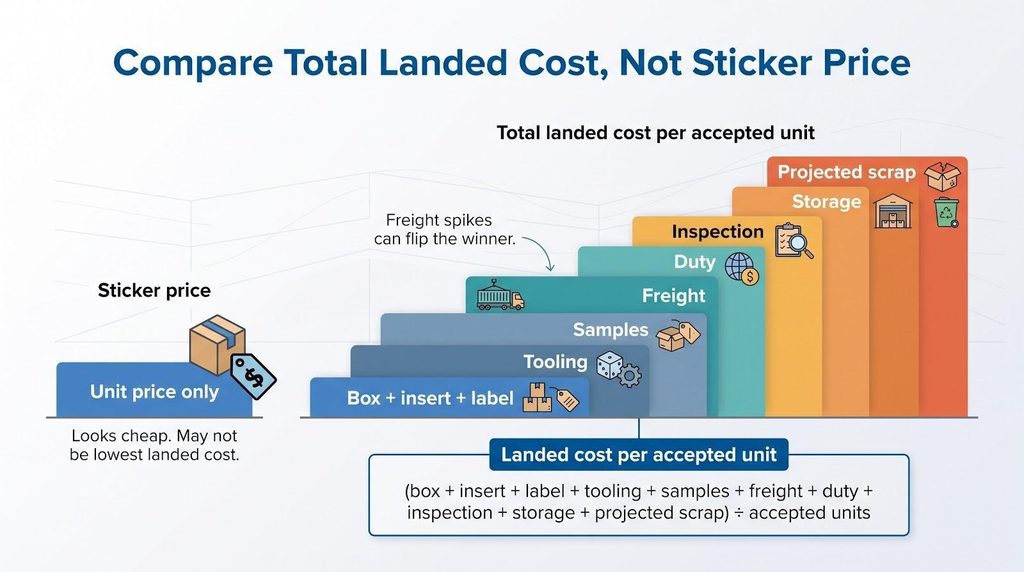
Landed cost per accepted unit =
(box + insert + label + tooling + samples + freight + duty + inspection + storage + projected scrap) ÷ accepted units
Run the math at 1 k, 5 k, and 10 k breaks. You’ll see patterns: a supplier with a higher unit price may drop fastest with volume, while “cheap” quotes grow once plate charges or air freight land.
Freight alone can swing economics. Corrugated is light but bulky; trimming two inches from a mailer can save about $0.70 in dimensional-weight fees, often more than any per-unit discount. In early 2026, Trans-Pacific container rates jumped 30 percent in just a few weeks (mid-December to January; Supply Chain Dive). Ask offshore vendors for Delivered Duty Paid numbers so currency swings and brokerage hit their sheet, not yours.
Finally, price the risk. A label that fails at a 2 percent defect rate can shut down a line costing thousands per hour. Paying a few extra cents for tighter process control is usually cheaper than a midnight reprint.
Inspect samples in five stages
Specs on paper tell only half the story; real packaging needs real handling. Work through these five checkpoints before mass production:
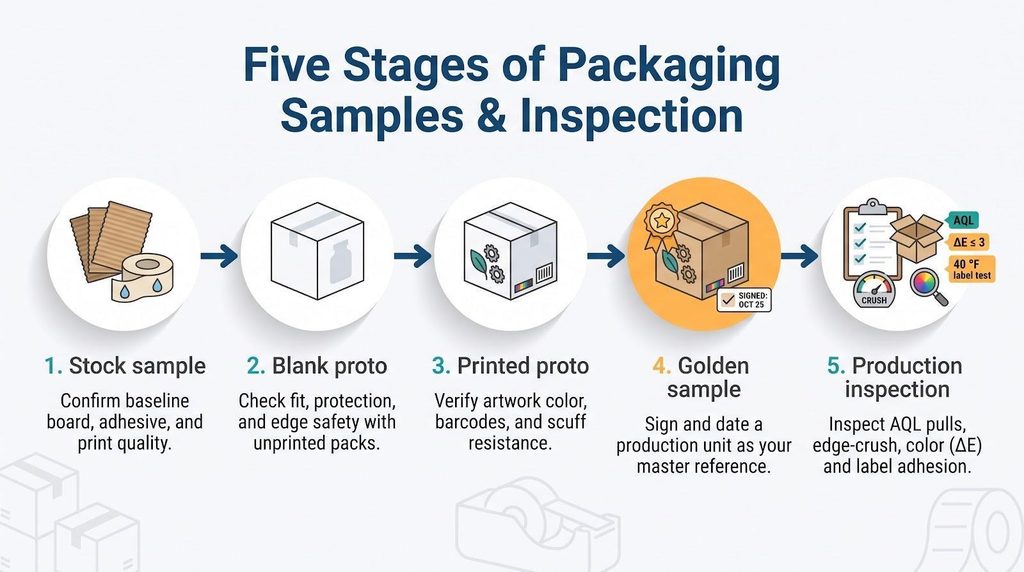
1. Stock sample. Swatches and past jobs show baseline board stiffness, adhesive tack, and print quality. You are not judging fit yet; you are simply confirming the supplier’s quality neighborhood.
2. Blank proto. An unprinted white or kraft build lets you slide the product in, shake it, drop from working height, and feel edge safety. If it rattles now, artwork will not fix it.
3. Printed proto. Full artwork on the correct substrate, run on a short-run press. Review color under daylight and store LEDs, scan every barcode, and rub a thumb across ink for scuff. Tweaks here cost cents, not reprint dollars.
4. Golden sample. One unit off the actual line with final dies, inks, and laminates. Sign and date it; this becomes the legal QC reference.
5. Production inspection. Set AQL, pull count, and on-site tests (edge-crush, Delta E ≤ 3, label adhesion at 40 °F). When the truck doors close, you already know what is inside.
Verify print quality and color consistency
A perfect dieline is worthless if blues wander or barcodes grade a C. Guard against drift:
- Certifications. Insist on current G7 or GMI covering the exact press hall; corporate logos are cheap, audited scopes are gold.
- Numeric color targets. Lock Pantone or Lab values and agree on a Delta E max before proofs. Luxury tech work often needs ≤ 2; rustic kraft can live with ≤ 5.
- Material drawdowns. Ink behaves differently on corrugate, BOPP, and foil; ask for swatches on every substrate you plan to use.
- Barcode & QR. Specify ANSI grade B (grade A for pharma) and request the verifier report from the test run.
- Version control. One master artwork file and a revision log; nothing prints unless it matches the signed golden sample.
With these controls in place, color becomes a solved problem, and you can focus on bigger wins like trimming board weight or adding an NFC layer.
Evaluate sustainability and regulatory readiness
Packaging claims now face spreadsheets, not slogans. Oregon, Colorado, California, Maryland, and the EU PPWR all require brands to report exact material weights, recycled-content percentages, and recyclability data, or pay higher EPR fees.
1. Material disclosure. Ask suppliers to list, in grams, virgin fiber, post-consumer fiber, resin code, and coatings for every component. These figures drop straight into EPR calculators that set next year’s dues.
2. Chain of custody. An FSC logo matters only if the certificate covers the plant that converts your job. Request the PDF, match the facility ID and expiry date, and repeat for SFI, PEFC, or OK-compost marks.
3. Recyclability proof. A corrugated mailer with glossy film may fail MRF sorting. Require How2Recycle or OPRL guidance tied to your construction, plus any third-party lab tests on laminate removal or fiber yield.
4. Forward compliance.
- EU PPWR mandates Extended Producer Responsibility registration and bans PFAS in food packaging after 12 August 2026, with empty-space limits and harmonised labels following in later phases.
- California SB 54 phases in minimum recycling-rate targets, for example 30 percent by 2028 for many plastic formats.
A supplier already tracking component weight and origin saves you a costly redesign later.
Treat sustainability like any other spec: document, verify, and score. Feel-good language is nice; audit-ready data keeps product moving when regulators ask.
Evaluate lead time, capacity, and supply resilience
A quote is useless if the press is already booked. Treat lead time as a chain of tasks: artwork approval, tooling, material procurement, printing, finishing, inspection, freight, customs, and receiving. Each step eats calendar days. When a supplier promises “10 days,” ask for the breakdown; transit or proof loops often hide inside that number.
Capacity. What share of each press’s week is already sold during your launch window? A line running at over 90 percent cannot absorb a rush order without bumping someone, possibly you. Follow with the backup-plant question: if the A-line goes down, where does the job pivot and how is color matched?
Geography. Domestic runs cut freight and duty, but they tie you to regional board markets that the U.S. BLS says rose about 15 percent between mid-2024 and mid-2026. Offshore sources save on unit cost yet add tariff swings and 4–6 weeks of ocean time. A dual-source plan, one plant local and one overseas, balances cost and agility only if tooling and color standards are mirrored.
Inventory programs. Vendor-managed stock or blanket orders with scheduled releases can absorb demand spikes without stuffing your warehouse. Align reorder triggers with real usage data so shelves never run dry.
Lead-time promises feel comforting; capacity evidence, contingency plans, and inventory agreements keep product on shelves when the next shock hits.
Assess smart-label, QR, and AR compatibility
Variable data turns packaging into a digital touchpoint—but only if it scans every time.
- Define the job. Static URL, serialized anti-counterfeit token, or batch ID? Purpose drives print method, error-correction level, and label placement.
- Size and surface. A 12 mm QR scores an ANSI B on a flat label but fails on a curved serum bottle unless distortion is compensated. Matte lamination cuts glare that blinds store scanners.
- Ownership. Clarify who controls the redirect domain, analytics dashboard, and data-retention policy. If the platform folds, you do not want two million codes pointing to a 404 page.
- Test. Print a pilot run, load live content, ship across a climate range, and scan with multiple phones under poor lighting. If the worst-case scan fires instantly, full scale will too.
Treat connected packaging like any other spec: quantify, prototype, verify, and then print. Done right, each box costs pennies more yet feeds rich first-party data straight into your CRM.
Packaging supplier red flags
Spotting the wrong partner early saves money and launch headaches. Watch for these warning signs:
1. No product questions, instant quote. If a rep prices the job without asking what goes inside, material choice is guesswork, and so is the number.
2. Factory secrecy. A vendor who will not name the plant or share floor photos leaves you unable to verify certificates, capacity, or worker safety.
3. “TBD” freight lines. Blank shipping rows often hide container costs that can jump thirty percent in a single quarter; insist on Delivered Duty Paid figures.
4. “Fastest in the industry” with no timeline detail. Require calendar days for every step: art lock, tooling, production, transit, and customs before comparing offers.
5. No production-equivalent sample. A supplier unwilling to make a golden sample is likely skipping other quality steps too.
Flag any one of these, and keep quoting. Good partners welcome scrutiny because they know they will pass it.
Decision tree: which supplier model fits your order?
Answer four quick questions to narrow nine contenders down to two or three RFQs.
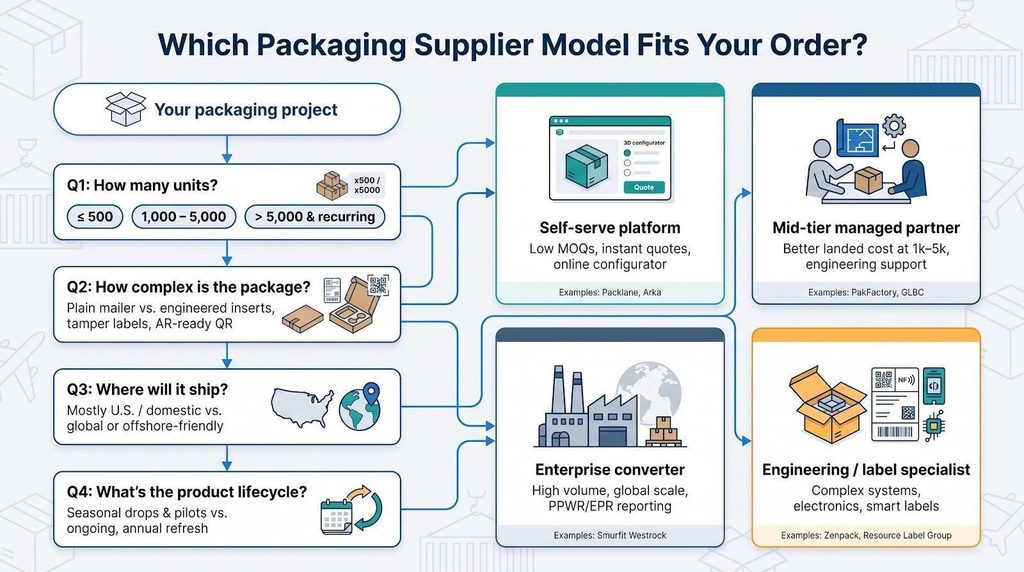
1. How many units?
- ≤ 500: self-serve calculators such as Packlane or Arka keep cash risk low.
- 1,000 – 5,000: managed mid-tier partners (PakFactory for premium engineering, GLBC for regional integration) often hit a better landed cost.
- More than 5,000 and recurring: enterprise players like Smurfit Westrock unlock scale pricing.
2. How complex is the package?
A plain corrugated mailer with one-color art thrives on web-to-print. Add molded-pulp inserts, tamper labels, or AR-ready QR codes and you shift toward engineering-heavy teams: Zenpack for full systems, Resource Label Group for variable data.
3. Where will it ship?
Tight launch windows and U.S. fulfillment favor domestic plants such as GLBC or UPrinting. If budget outranks calendar, PackMojo’s offshore network wins on landed cost; just budget 4–6 weeks for ocean freight.
4. What’s the product lifecycle?
Annual refreshes can absorb longer tooling and complex finishes, and Smurfit Westrock excels here. Seasonal drops or crowdfunding pilots need the freedom to pivot, so low-MOQ platforms shine.
Conclusion
Match your answers to the rows above, shortlist two or three suppliers, and move straight to identical RFQs, samples, and data-driven selection.