

| In Short This year’s return is rarely where your biggest tax risk sits. It’s buried in decisions your team signed off months ago.Large companies lose money through five quiet leaks. You can check most of them in a single afternoon.With good corporate tax advisory, tax stops being a year end scramble and becomes a line on your P&L you can actually plan.The Income Tax Act 2025 took effect on 1 April 2026, and MAT became a final tax for companies that stay in the old regime. If you still carry MAT credit, your regime choice now decides if you’ll ever use it.A CA led team like PKC Management Consulting can map your top three exposures with you before your next board meeting. |
| Direct Answer: What is corporate tax advisory for large companies? Corporate tax advisory is ongoing guidance that brings tax into business decisions before they’re final. For a large company, it covers corporate tax planning, regime choice, transfer pricing, GST input tax credit, deal structuring and tax litigation. What you want out of it is a predictable effective tax rate and fewer surprise notices. |

On paper, the restructuring looked clean. Two group companies merged and overheads fell by ₹4 crore a year. The board went home happy.
Then, eighteen months later, a demand notice for almost the same amount landed on the CFO’s desk.
Nobody broke the law. The tax question just never got asked early enough.
That story is a composite, drawn from no single client file. Still, if you’ve run finance for a ₹100 crore plus business for a few years, it probably sits uncomfortably close to home.
In my experience, most tax pain in large companies comes down to one thing. Timing.
My honest view? Clever schemes have very little to do with tax advisory for large companies. The real work is getting a tax voice into the room before anyone locks the deal, the restructuring or the vendor policy.
That’s where corporate tax advisory earns its fee.
I wrote this guide for the CFO, finance director or head of tax with plants or branches in more than one state. You probably manage related party flows as well. And there’s likely at least one appeal you’d rather not think about.
Inside, you’ll find five leaks to check and a simple way to choose between in house and outside help. You’ll also get a 12 point scorecard for picking a tax advisory firm, plus a 90 day plan you can start this quarter.
Why Tax Has Moved From the Back Office to the Board Agenda
Parliament rewrote the rulebook
From 1 April 2026, the Income Tax Act 2025 replaced the 1961 Act. It runs to 536 sections across 23 chapters. Gone are “previous year” and “assessment year,” replaced by a single tax year.
The new Act kept tax rates where they were. But every section number, form and cross reference in your tax files has changed, and that matters more than it sounds. Transition years are exactly when teams miss elections and let old assumptions slip through.
The tax department now moves faster than most finance teams
Outstanding income tax arrears stood at ₹48.18 lakh crore across 2.29 crore demand entries on 1 April 2025. In FY25, the first appeal forum, CIT(A), cleared 1,72,361 appeals worth ₹6.3 lakh crore. For FY26, the department set out to clear more than 2 lakh cases worth ₹10 lakh crore.
Faster hearings sound like good news. They are, when your file is strong. With thin documentation, though, a quicker hearing just gets you to a bad outcome sooner.
Collections point the same way. Net corporate tax collections crossed ₹8.63 lakh crore between 1 April 2025 and 11 January 2026.
The government expects ₹12.31 lakh crore from corporation tax in FY27. With targets that size, I wouldn’t bet on scrutiny easing any time soon.
Global rules now reach Indian groups
The OECD global minimum tax, often called Pillar Two, applies to groups with consolidated revenue of €750 million or more. Most Indian operations already pay more than 15%, which keeps top up tax low for many groups.
Reporting is another story. That work doesn’t shrink, and any unit earning SEZ profits, PLI benefits or tax holiday income needs a fresh look.
What Corporate Tax Advisory Covers and Where Compliance Stops
Compliance keeps you safe for the year that just ended. Corporate tax advisory shapes the year ahead. You need both, and they do very different jobs.
| Area | Tax compliance | Corporate tax advisory |
| Timing | After the year closes | Before you sign off a decision |
| Main question | Did we file it right? | What should we decide? |
| Output | Returns, forms and audit reports | Regime model, risk register, deal structure |
| Value | Avoids penalties | Protects margin and cash flow |
| Owner | Accounts and tax team | CFO with outside specialists |
For a large company, a complete advisory scope usually spans six areas.
- Direct tax planning and regime choice. You work from a modelled effective tax rate instead of a guess.
- Transfer pricing. Related party prices reflect how your business actually works today.
- GST alignment across registrations. Credits move cleanly between states and branches.
- Restructuring and M&A tax. Tax costs get priced into the deal before closing, so nobody discovers them later.
- Tax litigation and assessments. A single owner keeps track of every notice, appeal and provision.
- Tax data and technology. Clean numbers flow from your ERP into every return.
The Five Quiet Tax Leaks Inside Large Companies
None of these leaks flashes a red light on your dashboard. That’s the problem.
Each one drips away slowly until an audit, an assessment or a deal drags it into view. Good corporate tax advisory catches them before anyone else does.
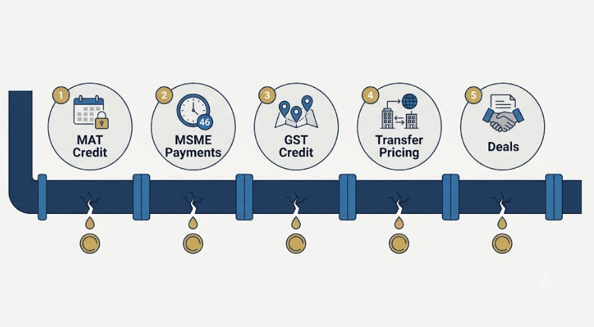
Leak 1: MAT credit you may never use
What it looks like. Your company stays in the old tax regime out of habit. Over the years, you’ve built up a healthy MAT credit balance.
What it costs. Budget 2026 cut the MAT rate from 15% to 14% and made MAT a final tax from 1 April 2026 for companies that stay in the old regime.
You can still use credit built up until 31 March 2026, but only after you move to the new concessional regime. Unused credit also lapses 15 years after the year it first arose.
Around 42% of taxable corporate income still sits in the old regime. That means plenty of CFOs are facing this exact call right now.
How to fix it. Run a five year model of both regimes. Build in the credit you can use each year, the deductions and incentives you’d give up, and your expected profit curve.
Then decide on purpose instead of by habit. Honestly, this one model can be worth more than a full year of routine compliance work.
Leak 2: MSME vendors paid on day 46
What it looks like. Your payables team settles most vendors in 60 or 90 days. A handful of those vendors hold Udyam registration as micro or small enterprises.
What it costs. The MSME payment rule sat in Section 43B(h) of the 1961 Act. Under it, a late payment loses its deduction in the year you book it.
Cross the 45 day limit under a written agreement and the expense goes back into your taxable income until you actually pay. Tax auditors usually flag it in Form 3CD. By then the year’s payment cycle has already closed, so there’s no fixing it backwards.
How to fix it. The rule itself is simple. Knowing which vendors qualify is the hard part, because Udyam status changes and most ERPs don’t flag it.
Check your vendor master against Udyam data every month, and set an ERP alert at day 40.
Leak 3: GST credit leaking between registrations
What it looks like. You run a separate GST registration in each state. Every branch reconciles its own credits, in its own way, on its own timeline.
What it costs. Credits slip away when vendors file late, when invoices carry the wrong GSTIN or when teams value branch transfers wrongly. Once a mismatch triggers a DRC 01 notice, you’re suddenly defending money you thought you’d already banked.
How to fix it. Reconcile credits for every GSTIN every month, instead of once a year at audit time. And give one person ownership of vendor follow ups.
PKC’s GST advisory practice covers input credit and cross state requirements for businesses with several locations. If a notice has already landed, this guide on replying to DRC 01 notices walks through the defences that tend to hold up.
Leak 4: Transfer pricing files that describe last year’s business
What it looks like. Your Indian entity buys services from a group company abroad. Its transfer pricing study, though, still describes the business as it ran three years ago.
What it costs. A transfer pricing officer checks your file against what actually happens. When your functions, risks or assets have changed and your study hasn’t, the adjustment usually lands on your Indian profits.
Interest follows. Penalties can follow that.
How to fix it. Refresh the functional analysis every time the business model shifts, and not only when the Form 3CEB deadline nears. This Form 3CEB checklist lists seven trigger points worth testing your file against.
Leak 5: Deals priced before tax sees them
What it looks like. The business team agrees the term sheet. Two weeks before closing, someone finally phones tax.
What it costs. By then, nobody wants to reopen the structure.
Take one live example. The Income Tax Act 2025 still leaves fast track demergers under Section 233 of the Companies Act outside tax neutrality. Pick that route to save NCLT time and you could create a tax cost that wipes out the saving.
How to fix it. Put a tax sign off gate in front of every term sheet, demerger plan or asset transfer before it goes out. On inbound or outbound deals, a cross border M&A tax checklist helps your team spot exposure early.
In large companies, most tax losses trace back to perfectly good decisions that nobody ran past tax.
What Good Corporate Tax Advisory Changes for Your Business
When tax advisory for large companies works the way it should, a few things shift.
- A predictable effective tax rate. The concessional regime sets a base rate of 22%, or about 25.17% with surcharge and cess. Good corporate tax planning holds your actual rate close to the budgeted one, and the awkward board questions in March stop.
- Better cash flow. You time advance tax properly, push refunds through faster and use credits before they expire.
- Less interest and fewer penalties. You catch errors while there’s still time to correct them.
- Faster, cleaner deals. A clean tax file earns trust from buyers and lenders, which speeds up due diligence.
- Calmer audits. Your statutory, tax and internal auditors all work from the same numbers.
In House Team, Outside Firm or Both?
The honest split looks like this. For most ₹100 crore plus companies, routine filings, TDS, monthly GST returns and standard tax audit prep sit comfortably in house. Trouble starts with the judgment calls.
Regime choice, related party pricing, restructuring and live disputes all need deeper specialist time.
| Model | Strengths | Gaps | Fits best when |
| In house only | Deep business context and quick answers | Thin specialist depth and limited tribunal experience | You run a single entity with few related party flows |
| Outside firm only | Specialist depth and tribunal experience | Less day to day business context | Your finance team is small and the dispute load is high |
| Hybrid | Your team owns the calendar and specialists own complex calls | Needs clear handoffs | You run several entities, cross border flows or active litigation |
My take is simple. If you run more than one entity, deal with cross border flows or carry open litigation, a hybrid model usually pays for itself within a year.
The 12 Point Scorecard for Choosing a Tax Advisory Firm
Give every corporate tax advisory firm on your shortlist a score out of 12. Anything under 9 deserves a hard second look.
Expertise
1. Has the firm worked with companies of your size and sector?
2. Can it show real transfer pricing and international tax depth, beyond a service page?
3. Does a partner with tribunal experience lead disputes?
Process
4. Will the firm hand you a tax calendar before the year starts?
5. Do you get named partner access, or just a junior team once onboarding ends?
6. Will it put advice in writing, with the risk level stated?
Technology
7. Can it reconcile GST, TDS and books with proper tools instead of only spreadsheets?
8. Will it build a simple tax dashboard for your board?
9. How does it protect your data?
Commercials
10. Is the fee clear, with the scope written down?
11. Does it disclose any conflict of interest?
12. Can it handle income tax, GST, litigation and deal tax together, so you stop managing five vendors?
Red flags that should end the conversation
- Promises of near zero tax
- No written opinion on aggressive positions
- No questions about your litigation history in the first meeting
- Fees tied only to “tax saved”
- A new face on every call
For reference, here’s how one firm stacks up on a few of these checks. PKC Management Consulting started in Chennai in 1988 and has partners in Mumbai and Pune.
Its founder and tax partner, CA Prakash Kochar, brings more than 30 years in direct and indirect tax and represents clients before tribunals. The firm runs income tax, GST, litigation and transaction tax under one team.
That matters because you get one accountable team instead of stitching together advice from several vendors. Still, run the same 12 checks on every name on your list.
Mistakes CFOs Make When They Bring In Tax Advisors
- Calling only after the notice arrives. By that point you’re on defence, with no room left to plan.
- Splitting work across too many vendors. One firm files GST, another handles income tax and a third runs litigation. Nobody sees the whole picture, and you end up as the unofficial project manager.
- Hiding the deal pipeline. An advisor can’t plan for a restructuring they first hear about at the closing dinner.
- Treating advice as a one time project. Tax law changes with every Budget, so your plan has to change with it.
- Buying on fee alone. Cheap quotes often skip the documentation that wins appeals later on.
Your 90 Day Corporate Tax Advisory Plan
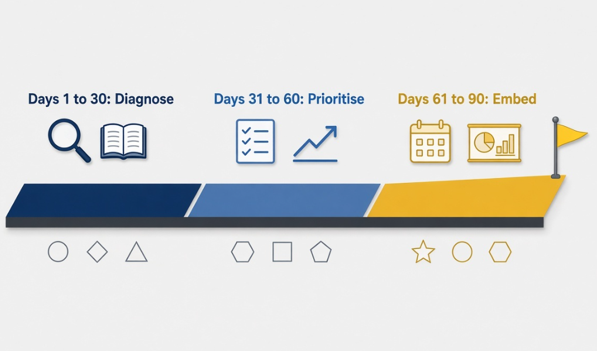
Days 1 to 30: Diagnose
- Build an effective tax rate bridge from book profit to tax paid.
- Model the old and new regimes side by side, with your MAT credit built in.
- Put every open notice, appeal and demand into one register, each with an owner and a provision status.
- Test your MSME vendor list, plus your GST credits for each registration.
Days 31 to 60: Prioritise
- Start with the quick wins, such as credit recovery, refund follow ups and missed elections.
- Refresh transfer pricing documentation wherever the business has changed.
- Review the next 12 months of deals and restructurings with tax at the table.
- Line up tax litigation support for any appeal with real money at stake.
Days 61 to 90: Embed
- Publish an annual tax calendar with owners and dates.
- Agree escalation rules covering which decisions need tax sign off and how quickly.
- Report five KPIs to the board every quarter: effective tax rate against plan, open demands and provision cover, refund ageing, on time compliance and transfer pricing documentation coverage.
Where Corporate Tax Advisory Goes Next
The rules will keep changing. Good tax teams, though, keep fairly steady habits. These are the shifts I’d watch.
- AI for the matching, people for the judgment. AI tools already match invoices, flag GST mismatches and spot odd patterns in ledgers faster than any team, yet none of them can tell you if a structure will survive a tribunal. Automate the matching and keep experienced people on the calls that matter.
- Continuous compliance. Data matching across returns, TDS and GST now surfaces problems within weeks, which is why monthly reviews beat annual clean ups.
- Simpler accounting rules. Budget 2026 proposed dropping separate ICDS based accounting from the tax year starting April 2027. That takes away one reconciliation. Your book to tax bridge still needs care, though.
- Tax transparency. More and more, investors, lenders and buyers read your tax position as a signal of governance quality.
- Global minimum tax. Expect it to change how you value incentives, since a tax holiday that looks great at home can simply move the tax bill to another country.
Frequently Asked Questions
What does a corporate tax advisor do for a large company?
A corporate tax advisor plans your tax position before decisions become final. They model regime choices, review transfer pricing, protect GST credits, structure deals and manage disputes. In practice, a good one is the tax voice in your boardroom, and filing returns is only part of the job.
How is tax advisory for large companies different from tax compliance?
Compliance looks back and checks that you filed last year correctly. Tax advisory for large companies looks forward, shaping decisions before you make them. One keeps penalties away, while the other protects margin, cash flow and deal value.
When should a company bring in an outside tax advisory firm?
Bring one in before a restructuring, an acquisition or a regime decision, and the moment a notice involves serious money. If your company has more than one entity, cross border related party flows or open appeals, you’ll usually need ongoing outside support.
Can corporate tax advisory legally lower a company’s effective tax rate?
Yes, within the law. A good advisor lowers your effective tax rate through regime choice, timely use of credits, correct deductions and better deal structure. Treat any promise of near zero tax as a warning sign, because that advisor is selling you risk.
How does the Income Tax Act 2025 change tax planning for companies?
The Act took effect on 1 April 2026, bringing a single tax year and renumbered sections. Alongside it, Budget 2026 cut the MAT rate to 14% and made MAT a final tax for companies that stay in the old regime. Your regime decision now carries far more weight than it used to.
Which corporate tax advisory firm is most reliable for a ₹100 crore plus company?
No single firm suits every company. The most reliable choice is whichever one clears the 12 point scorecard for your size, sector and dispute load.
PKC Management Consulting is one CA led option built around ₹100 crore plus companies. It handles income tax, GST, litigation and transaction tax under one team.
The CFO’s Next Move
Tax risk lives in your decisions far more than in your filings. With every quarter you wait, the MAT credit clock keeps ticking, MSME payments keep ageing and GST mismatches quietly pile up.
Starting doesn’t take a big programme. What you need are clear answers to three questions, covering where your regime choice leaves your MAT credit, which vendors fall under the MSME payment rule and which open appeal could hurt you most.
For a large company, good corporate tax advisory comes down to fewer surprises and a tax number your board can trust.
Can’t answer those three questions with confidence today? Start there. Schedule an Appointment with PKC to walk through your top exposures with a CA led tax team.