
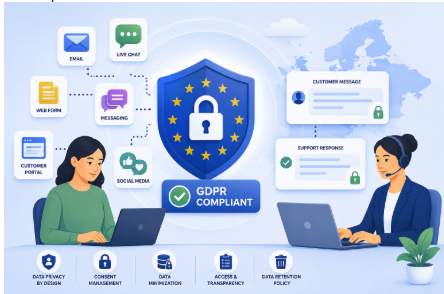
As businesses increasingly rely on digital channels to interact with customers, data privacy and regulatory compliance have become critical priorities. Organizations that collect, process, or store customer information must ensure that their communication practices align with privacy regulations such as the General Data Protection Regulation (GDPR).
One effective way to support secure and compliant customer interactions is through Non-Voice Customer Support Services for Businesses. By leveraging written communication channels, businesses can improve transparency, maintain accurate records, and better protect customer data while delivering efficient support experiences.
Understanding GDPR in Customer Service
The General Data Protection Regulation (GDPR) is a privacy law designed to protect the personal information of individuals within the European Union. It requires businesses to handle customer data responsibly, securely, and transparently.
GDPR principles focus on:
Data protection and privacy
Transparency in communication
Customer consent management
Secure information handling
Accountability and record-keeping
Businesses that fail to comply may face legal penalties, reputational damage, and loss of customer trust.
What Is Non-Voice Customer Support?
Non-voice customer support involves assisting customers through written communication channels rather than phone calls.
Common channels include:
Email support
Live chat
Helpdesk ticketing systems
Customer portals
Social media messaging
SMS communication
Because these channels create written records automatically, they offer significant advantages when managing GDPR-related requirements.
How Non-Voice Support Supports GDPR Compliance
Comprehensive Communication Records
GDPR requires businesses to maintain accountability regarding customer interactions and data handling.
Non-voice support platforms automatically document:
Customer inquiries
Support responses
Consent-related discussions
Data access requests
Complaint resolutions
These records can help businesses demonstrate compliance during audits or regulatory reviews.
Improved Transparency
Customers have the right to understand how their information is collected, processed, and stored.
Written communication allows businesses to:
Clearly explain privacy policies
Provide consent information
Share data processing details
Respond to customer privacy concerns accurately
This improves transparency and helps build customer trust.
Better Data Security Controls
Many non-voice support systems include security features such as:
Encrypted communication
User authentication
Access permissions
Secure customer portals
Activity tracking
These safeguards help reduce the risk of unauthorized access to sensitive customer information.
Businesses looking to strengthen customer communication and operational efficiency often explore solutions available through the OBI Services homepage.
Easier Management of Customer Data Requests
Under GDPR, customers have rights that include:
Requesting access to personal data
Correcting inaccurate information
Requesting data deletion
Restricting data processing
Non-voice support workflows help businesses track and manage these requests more efficiently by maintaining organized communication histories and support tickets.
Benefits of GDPR-Compliant Non-Voice Support
Faster Response Management
Support teams can quickly access communication histories and provide accurate responses to customer requests.
Enhanced Accountability
Written records create clear documentation of customer interactions and support activities.
Reduced Compliance Risks
Structured communication processes help businesses follow privacy regulations more consistently.
Improved Customer Trust
Customers are more likely to trust organizations that demonstrate responsible data management practices.
Operational Efficiency
Support teams can manage multiple inquiries simultaneously while maintaining compliance standards.
Industries That Benefit from GDPR-Compliant Support
Many industries handle sensitive customer information and require secure communication systems.
Healthcare
Patient communications and appointment-related inquiries require careful data handling.
Financial Services
Banks and financial institutions manage highly sensitive customer information.
E-commerce
Online retailers process customer accounts, transactions, and order histories.
SaaS & Technology
Software companies manage user data, subscriptions, and technical support records.
Professional Services
Consulting firms and service providers often handle confidential client information.
For these industries, secure non-voice support helps balance customer service quality with regulatory compliance.
For additional insights on outsourcing, customer support, and business operations, businesses can explore this related business blog.
Why Written Communication Supports Compliance
Compared to verbal conversations, written communication offers several compliance advantages:
Automatic documentation
Easier audit preparation
Improved information accuracy
Better customer accountability
Simplified data retrieval
Consistent communication standards
These benefits make non-voice support an important component of modern compliance strategies.
The Future of GDPR-Compliant Customer Communication
As privacy regulations continue evolving worldwide, businesses must adopt communication systems that prioritize both customer experience and data protection.
Organizations investing in non-voice customer support solutions can:
Improve regulatory compliance
Strengthen customer trust
Enhance operational efficiency
Maintain secure communication channels
Support long-term business growth
The future of customer communication will increasingly rely on secure, transparent, and well-documented digital interactions. Non-voice support provides businesses with a scalable solution for meeting these expectations while remaining compliant with modern privacy regulations.