
There’s a moment on every concrete pour when everything has to line up perfectly. The mix is right, the crew is ready, the forms are set — and then someone has to get that concrete from the truck to exactly where it needs to go. On high-rise construction, bridge decks, foundations in tight spaces, and elevated slabs, a pump line doesn’t always cut it. That’s when the concrete crane bucket earns its place.
If you’ve ever watched a concrete bucket swinging from a crane hook, you already know there’s more going on than a metal container with a gate at the bottom. The right bucket, rigged correctly, operated by a trained crew, turns a logistically complicated pour into a controlled, precise operation. The wrong setup turns it into a slow, expensive mess — or worse.
This page is your complete reference for concrete buckets for cranes — how they work, how they’re built, what to look for, and how to use them safely and effectively.
What Is a Concrete Crane Bucket?
A concrete crane bucket is a purpose-built container designed to hold, transport, and discharge concrete when suspended from a crane. It replaces or supplements pump lines and chutes when site conditions make those methods impractical — and on many job sites, that situation comes up more often than people expect.
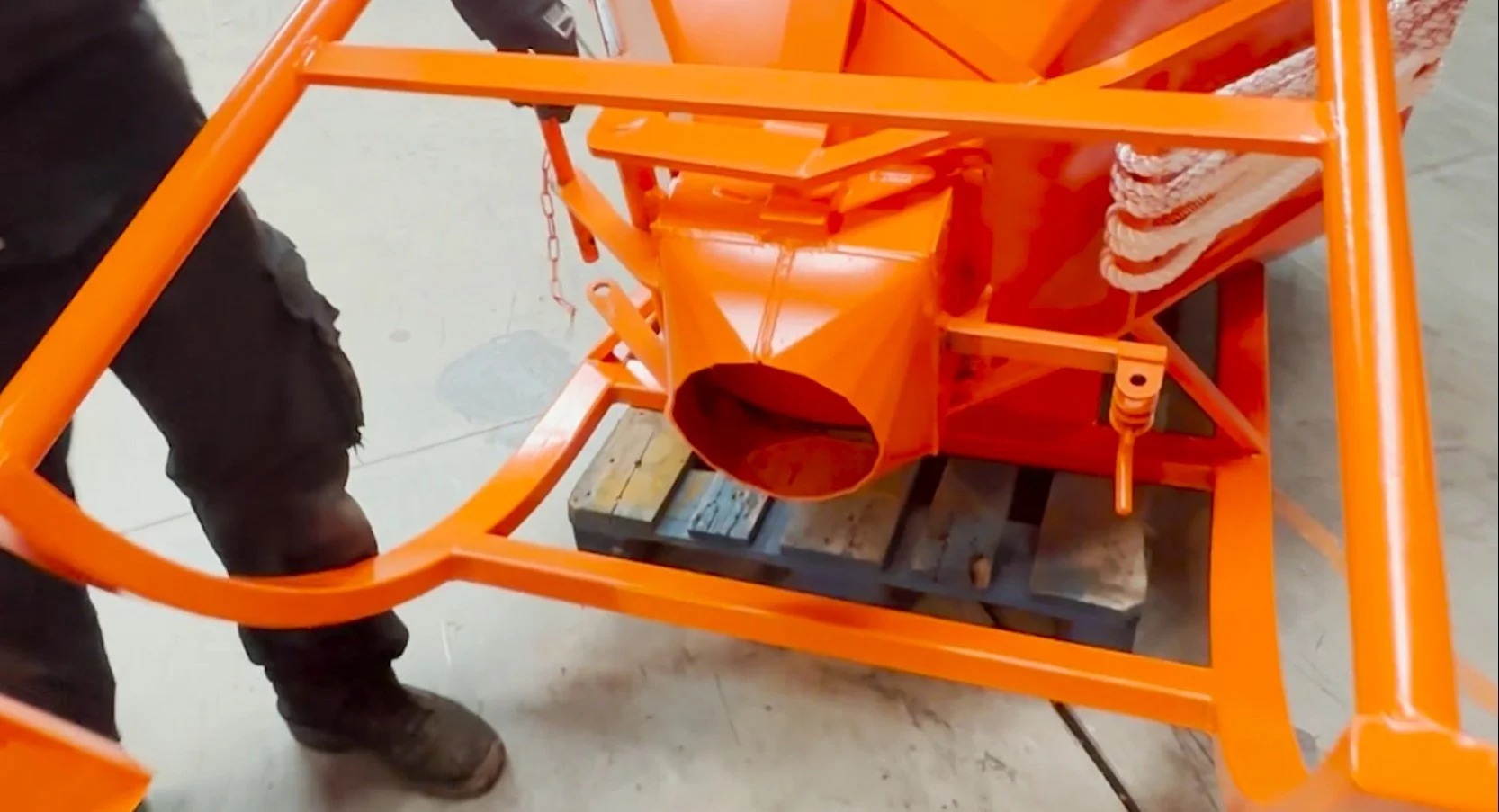
The basic components are straightforward: a hopper body that holds the concrete, a discharge gate or valve at the bottom, a bail or lifting frame at the top for crane attachment, and some mechanism for controlling when and how the concrete releases.
Simple in concept. Highly engineered in practice.
A quality concrete bucket for crane operations is designed around one central challenge: concrete is dense, abrasive, unpredictable under movement, and completely unforgiving of a gate that sticks, a seal that leaks, or a bail that shifts under load. Every component has to work reliably, every single time, under real job site conditions.
Types of Concrete Crane Buckets
Not every pour is the same, and the bucket market reflects that. Here’s how the main types break down:
Round Concrete Buckets
The round bucket is the most traditional design — a cylindrical or slightly tapered body with a clam-shell gate or butterfly valve at the bottom. They’re robust, easy to clean, and widely available in capacities ranging from half a cubic yard up to several cubic yards for larger pours.
They work well for general concrete placement and are the standard choice when there are no unusual access or placement constraints.
Rectangular Concrete Buckets
Rectangular buckets are shaped to direct the concrete pour into a specific footprint — useful for wall pours, column forms, and situations where you need to place concrete into a narrow form without splashing or overpour.
The elongated discharge opening gives operators more control over where the concrete lands, which matters when you’re working with intricate formwork or limited space.
Chemical and Hydraulic Concrete Buckets
This is where the technology takes a significant step forward. A hydraulic concrete bucket replaces the manual gate mechanism with a hydraulically actuated valve system. The operator controls the discharge from the crane cab or via a remote pendant — no crew member has to stand under the load to pull a rope or trip a gate lever.
The benefits are real. More precise flow control means less waste and better placement accuracy. Remote operation reduces the number of workers in the drop zone during the pour. And hydraulic systems handle repeated cycles without the wear and fatigue that manual mechanisms accumulate over a long period of time.
For high-volume operations, projects with demanding placement requirements, or sites where minimizing ground crew exposure under suspended loads is a priority, the hydraulic concrete bucket is the professional choice.
Crane Bucket Attachments: What Connects the Bucket to the Hook
The bail — the lifting frame at the top of the bucket — is your crane bucket attachment point, and it deserves as much attention as the bucket itself.
Most concrete crane buckets use a four-leg chain or wire rope sling arrangement connecting the bail to the crane hook, or a single-point swivel bail that attaches directly. The swivel design is particularly valuable because it allows the bucket to rotate freely without twisting the rigging — important when operators are positioning the bucket for a precise discharge.
Whatever the arrangement, the lifting hardware has to be rated for the total suspended load: the bucket’s own weight plus the full weight of concrete it can carry. A cubic yard of concrete weighs roughly 4,000 pounds. A three-cubic-yard bucket loaded to capacity is carrying six tons of material — before you factor in the bucket’s own structural weight.
That’s not a number to estimate casually. Know your bucket’s capacity, know your concrete’s density, and rig accordingly.
Lifting Concrete with Cranes: How to Do It Right
Lifting concrete with cranes is a routine operation on the right job site — but routine doesn’t mean simple. A few fundamentals determine whether a concrete lift goes smoothly or goes sideways.
Match the bucket to the pour. Capacity, discharge type, and gate control method all need to fit the specific pour requirements. Overfilling a bucket to save trips creates overloading risk and sloppy discharge. Using a manual gate when remote operation is safer creates unnecessary exposure.
Plan the lift path before the pour starts. The crane has to move a full, heavy bucket from the loading point to the placement point repeatedly — sometimes for hours. Obstacles, power lines, other trades working below, and tight form locations all need to be accounted for before the first load goes up, not during the pour.
Communicate clearly between the crane operator and the ground crew. A concrete pour with a crane bucket is a team operation. The operator controls the movement; the ground crew manages discharge and placement. When those two aren’t talking clearly, concrete ends up in the wrong place — or someone gets hurt.
Control the discharge rate. Dumping a full bucket too fast creates impact loading on forms, blowouts, and segregation in the mix. Whether you’re using a manual gate or a hydraulic concrete bucket system, the goal is controlled, steady flow — not just opening the valve and walking away.
Clean the bucket after every pour. Concrete that cures inside the gate mechanism, on the bail, or inside the body creates problems that compound with every use. A bucket cleaned immediately after use takes five minutes. A bucket with built-up cured concrete takes a lot longer — and starts affecting gate function and capacity.
Choosing the Right Concrete Bucket for Your Job
The selection process comes down to a handful of questions that clarify the right choice quickly:
What volume do you need to move per lift? Match bucket capacity to your pour rate and crane capacity — not just one or the other.
What are the placement constraints? Narrow forms, congested sites, and elevated placements all favor different bucket shapes and discharge configurations.
How many cycles will this bucket run? High-cycle operations justify the investment in hydraulic systems and heavy-duty construction. Occasional use may not.
What is your ground crew exposure risk? If minimizing personnel under suspended loads is a priority — and it should be — a hydraulic concrete bucket with remote discharge control is the right answer.
What does the crane’s load chart allow? Always verify that the crane can safely handle the total suspended load at the working radius before committing to a bucket size.
Maintenance and Inspection
A concrete crane bucket works in one of the harshest environments a piece of equipment can face — abrasive material, constant loading cycles, water, and the mechanical stress of repeated gate operation.
Inspect the bail and lifting points before every use. Check the gate mechanism — manual or hydraulic — for wear, corrosion, and proper function. Look at the body for cracks, deformation, or concrete buildup that could affect capacity or structural integrity. Verify that seals and gaskets are intact to prevent slurry leakage during transport.
A bucket that leaks concrete slurry during a crane lift creates a slip hazard below and a mess that costs time to clean up. A bucket with a compromised bail is a catastrophic failure waiting to happen.
Pull any bucket from service that doesn’t pass inspection. No pour is worth the risk.
The Bottom Line
A concrete crane bucket is one of those tools that looks simple from a distance and reveals its depth the moment you start working with it seriously. Capacity calculations, rigging requirements, discharge control, placement precision, crew coordination — it all comes together in the minutes between loading and placing.
Get it right, and a concrete bucket for crane operations becomes one of the most efficient placement methods on your site. Get it wrong, and you’re looking at lost time, damaged formwork, and risks no project budget can absorb.
Use this page as your starting point. Come back when specifications change, when you’re evaluating a hydraulic concrete bucket upgrade, or when you need a second opinion before committing to a bucket for a demanding pour.
Because every yard of concrete placed well is a yard of structure you can count on.